Head to head
KENT Grand Plus vs Pureit Copper+ RO: Which Should You Buy?
| Specification | ||
|---|---|---|
| Our score | 8.9/10 | 8.4/10 |
| Street price (indicative) | ₹16,499 | ₹15,999 |
| MRP | ₹20,500 | ₹22,000 |
| Brand | KENT | Pureit |
| Best for | Families on borewell, tanker or high-TDS municipal supply who want the safest all-round choice. | Safety-first households, and anyone who has previously forgotten filter changes. |
| Annual running cost (indicative) | ₹3,500 | ₹3,800 |
| Purification | RO + UV + UF + TDS Controller | RO + UV + MF + Copper Charge technology |
| Storage capacity | 9 litres | 8 litres |
| Purification capacity | 20 litres/hour | 12 litres/hour |
| Max input TDS | 2000 ppm | 2000 ppm |
| Water recovery | Up to 50% (Save Water technology) | — |
| Tank material | Food-grade plastic | — |
| Filter life | RO membrane ~12 months, sediment/carbon ~6 months | — |
| Power | 60 W | 36 W |
| Warranty | 1 year warranty + 3 years free service | 1 year |
| Dimensions | 39.5 x 26.5 x 55.5 cm | — |
| Mounting | Wall-mount or counter-top | Wall-mount or counter-top |
| Copper | — | Copper Charge dispenses copper-enriched water |
| Safety | — | Auto shut-off when germkill kit expires |
| Purification score | 9.2 | 8.8 |
| Build quality score | 8.5 | 8.2 |
| Value for money score | 8.8 | 8.6 |
| Running cost score | 8.4 | 8.1 |
| Service network score | 9.5 | 8.8 |
| Pros |
|
|
| Cons |
|
|
| Where to buy |
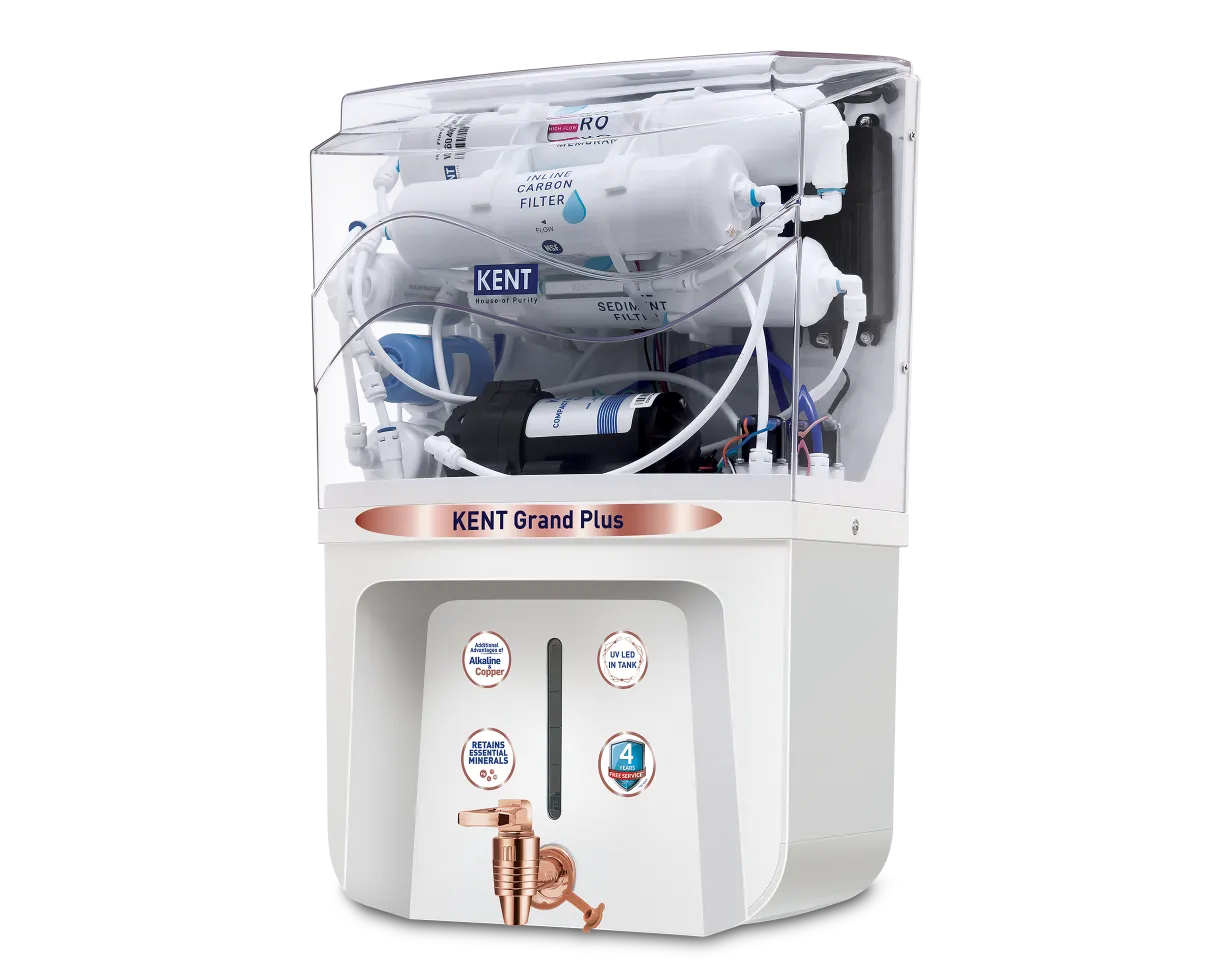

Choose the KENT Grand Plus if…
- Handles input TDS up to 2,000 ppm, which covers almost every Indian borewell
- Save Water technology recovers roughly 50% versus the 20-25% of older RO designs
- TDS controller lets you dial mineral retention rather than stripping the water flat
- 9-litre tank is genuinely enough for a family of five during a supply cut
₹16,499 · Full review
Choose the Pureit Copper+ RO if…
- Hard auto shut-off means you physically cannot drink through an expired filter
- 8-litre tank at a competitive price
- HUL's retail and service reach extends into tier-3 and tier-4 towns
- Copper Charge implementation is well engineered
₹15,999 · Full review
The deciding factors
If someone asks for one water purifier recommendation without telling me anything about their water, this is the answer. The Grand Plus is not the prettiest or the cheapest unit in this list, but it is the most consistently correct one: an RO membrane rated to 2,000 ppm input, UV and UF stages behind it, and a TDS controller so that low-TDS supply does not get stripped to tasteless.
Against that, Pureit Copper+ RO makes its case differently: Pureit's defining design decision is the one most buyers complain about and I think is exactly right: when the germkill kit reaches the end of its rated life, the purifier stops dispensing. Not a beep, not a blinking light you learn to ignore — it stops. Every other brand relies on you noticing an indicator, and in practice most Indian households run filters months past their rated life, which quietly turns a purifier into a contamination source.
Our practical advice: unless the KENT Grand Plus's specific advantages match a real constraint you have — tank size for long water cuts, a higher TDS rating for brackish supply, hot water you will genuinely use — the cheaper unit is the better purchase. In this category, paying for capability you will never use is the most common way money gets wasted.
Frequently asked questions
KENT Grand Plus or Pureit Copper+ RO — which is better?
What is the price difference between KENT Grand Plus and Pureit Copper+ RO?
Which handles high TDS water better, KENT Grand Plus or Pureit Copper+ RO?
Still undecided?
Tell us your city, your water source and your TDS if you know it, and we will tell you which of these two is right for you — or whether a third option fits better.