
Skip to content

Water Quality

UV Water Purifiers: How UV Works, and When It Is Enough

A UV purifier passes water through a chamber containing a UV-C lamp, usually emitting at around 254 nm. That wavelength is absorbed by nucleic acids and damages them enough that bacteria, viruses and protozoa can no longer reproduce. It is fast, adds no chemicals, changes nothing about taste, and produces no by-products.

It is also the most misunderstood technology in Indian water purification, because its limitation is absolute and invisible: UV changes nothing that is dissolved in the water. It is a microbiological tool and nothing else.

Used for what it is, UV is excellent — and in much of Kerala, coastal Karnataka, Himachal, Srinagar and piped Mumbai it is genuinely all a household needs.

What UV does and does not address

ContaminantUV effect
Bacteria (E. coli, cholera, typhoid)Inactivated effectively
Viruses (rotavirus, hepatitis A)Inactivated effectively
Protozoan cysts (Giardia, Cryptosporidium)Inactivated at adequate dose
TDS / dissolved saltsNo effect whatsoever
Arsenic, fluoride, lead, nitrateNo effect whatsoever
Hardness / scaleNo effect
Turbidity / suspended solidsNo removal — and turbidity blocks UV, reducing effectiveness
Chlorine, taste and odourNo effect — that is activated carbon's job

Important

If you are in West Bengal, Bihar, Assam, eastern UP, Rajasthan or Punjab, a UV-only purifier gives you no protection against the contaminant that matters most in those regions. Arsenic and fluoride are invisible, tasteless, and untouched by UV.

Why dose and water clarity matter

UV effectiveness is a function of dose — intensity multiplied by contact time, measured in mJ/cm². Adequate dose depends on the organism, and protozoan cysts need considerably more than bacteria.

Critically, UV only works on water it can penetrate. Turbidity, suspended solids and iron all absorb or scatter UV, and organisms can shelter behind particles. This is why UV always sits after filtration, never before it, and why a UV purifier on visibly cloudy water is not doing what its rating claims.

  • A sediment pre-filter ahead of the lamp is not optional — it is what makes the UV dose meaningful.
  • Scale and iron deposits on the quartz sleeve cut transmitted intensity sharply. Clean the sleeve at each service.
  • Higher flow rate means less contact time and therefore lower dose. Do not exceed the rated flow.
  • A lamp that is on is not necessarily a lamp that is working — output declines with age well before failure.

UV, UF or both?

UV and UF are complementary rather than competing. UV inactivates organisms but leaves their bodies in the water and offers no barrier if the lamp fails. UF is a physical membrane that blocks bacteria and cysts, works without electricity, and keeps working when the lamp does not.

For low-TDS supply, UV+UF together is the configuration we recommend: the UF membrane is a fail-safe barrier, and the UV handles what passes through. It also means a power cut does not leave you unprotected.

Maintenance

  • UV lamp: replace every 9,000–12,000 hours, in practice roughly annually. Cost ₹500–₹1,500.
  • Quartz sleeve: clean at every service; replace if etched or clouded.
  • Sediment pre-filter: every 6–12 months — this protects UV effectiveness directly.
  • Carbon filter (if fitted): every 6–12 months for taste and chlorine.
  • Check the lamp-status indicator regularly. Some purifiers will keep dispensing with a failed lamp, which is silent failure.

Our tested picks in this category

Ranked on our editorial score. Full reviews, running costs and buy links on each.

AO Smith Z9 Green RO water purifier by AO Smith — product image
🏆 Best Premium / Best Hot Water

AO Smith Z9 Green RO

by AO Smith

9.0/10our editorial score
₹33,990M.R.P. ₹42,00019% off

Indicative price, verified 2026-08-01. Confirm on the marketplace before buying.

Running cost: ₹4,500/year in filters & servicing

  • RO + SCMT
  • 9 litres tank
  • Up to 3000 ppm TDS
  • Hot water
  • TDS controller

The Z9 is the best domestic water purifier sold in India, and I say that fully aware of the price. Three things justify it. First, the 3,000 ppm input rating — nothing else mainstream goes that high, and in Jodhpur, Bikaner, Agra or coastal Chennai that headroom is the difference between a membrane that lasts a year and one that dies in five months. Second, Advanced Recovery Technology, which is the most substantive water-saving engineering in the category rather than a sticker. Third, the hot water: 45°C, 80°C and 100°C on demand, properly child-locked, which quietly eliminates the kettle from your counter.
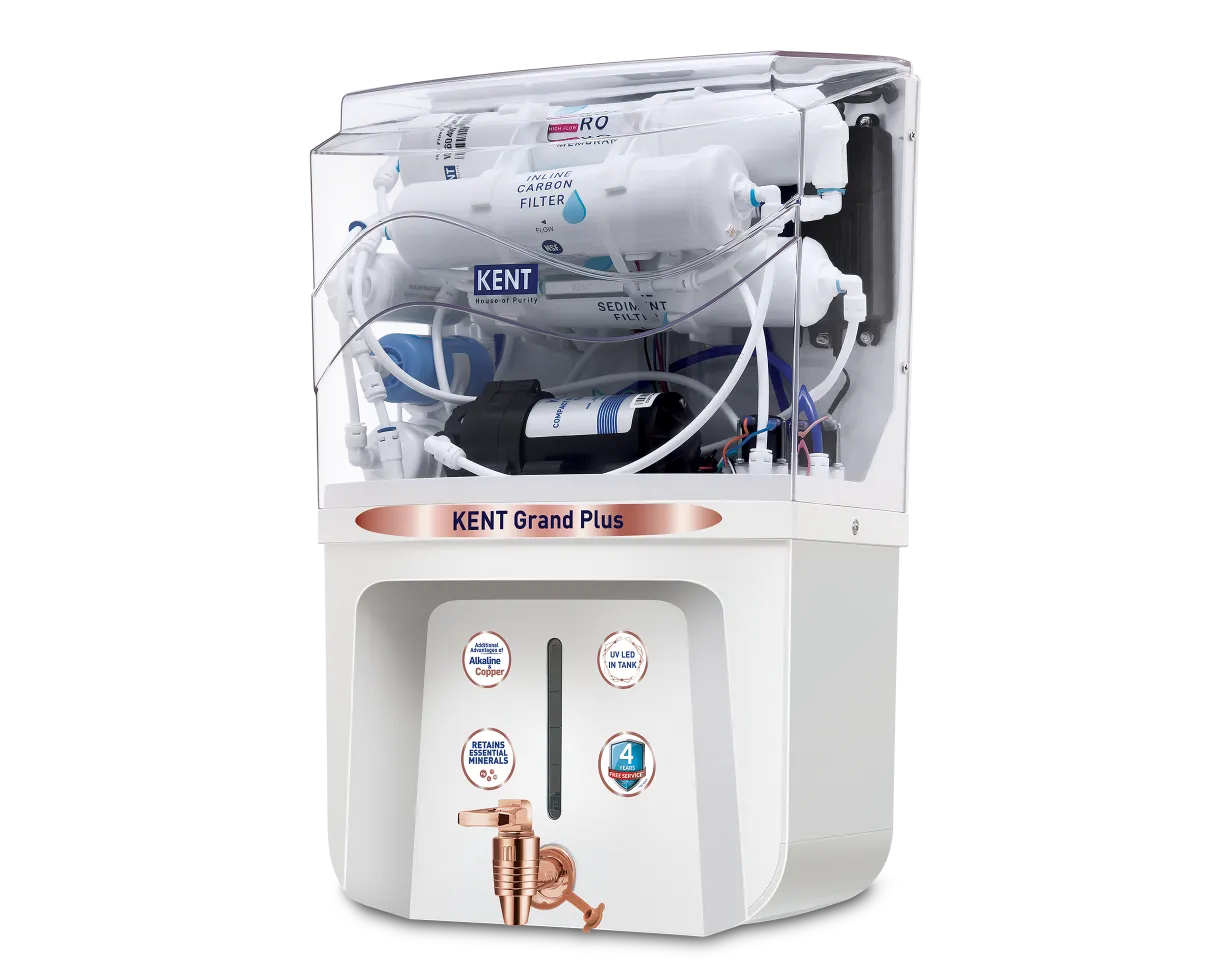
KENT Grand Plus water purifier by KENT — product image
🏆 Best Overall

KENT Grand Plus

by KENT

8.9/10our editorial score
₹16,499M.R.P. ₹20,50020% off

Indicative price, verified 2026-08-01. Confirm on the marketplace before buying.

Running cost: ₹3,500/year in filters & servicing

  • RO + UV + UF + TDS Controller
  • 9 litres tank
  • Up to 2000 ppm TDS
  • TDS controller
  • High water recovery

If someone asks for one water purifier recommendation without telling me anything about their water, this is the answer. The Grand Plus is not the prettiest or the cheapest unit in this list, but it is the most consistently correct one: an RO membrane rated to 2,000 ppm input, UV and UF stages behind it, and a TDS controller so that low-TDS supply does not get stripped to tasteless.

LG PuriCare WW182EP water purifier by LG — product image
🏆 Best Tank Hygiene

LG PuriCare WW182EP

by LG

8.8/10our editorial score
₹31,990M.R.P. ₹39,00018% off

Indicative price, verified 2026-08-01. Confirm on the marketplace before buying.

Running cost: ₹4,400/year in filters & servicing

  • RO + Dual Protection Sterilising Care UV
  • 8 litres tank
  • Up to 2000 ppm TDS

Almost every purifier sold in India stores purified water in a sealed plastic tank at room temperature for hours at a time. In a Chennai or Kochi summer, that is an excellent environment for biofilm, and it is the failure mode nobody markets against. LG's answer is the right one on both counts: a stainless-steel tank that resists colonisation, and an automatic UV cycle that sterilises the tank and the outlet tap every couple of hours whether you remember to think about it or not.

Aquaguard Delight NXT water purifier by Aquaguard — product image
🏆 Best Service Network

Aquaguard Delight NXT

by Aquaguard

8.7/10our editorial score
₹17,990M.R.P. ₹23,50023% off

Indicative price, verified 2026-08-01. Confirm on the marketplace before buying.

Running cost: ₹4,200/year in filters & servicing

  • RO + UV e-boiling + UF + MTDS + Active Copper
  • 6 litres tank
  • Up to 2000 ppm TDS
  • Copper
  • TDS controller

The Delight NXT is what I recommend to people who have been burned by bad service. Purification-wise it is closely matched with the KENT Grand Plus — same 2,000 ppm ceiling, same core stages — so the decision comes down to two things: tank size and who shows up when it breaks. KENT gives you 9 litres; Aquaguard gives you 6 litres and Eureka Forbes' direct field force, which in my experience is the most dependable in Indian appliances.

AO Smith X7 water purifier by AO Smith — product image

AO Smith X7

by AO Smith

8.6/10our editorial score
₹23,490M.R.P. ₹30,00022% off

Indicative price, verified 2026-08-01. Confirm on the marketplace before buying.

Running cost: ₹4,000/year in filters & servicing

  • RO + SCMT + Mineraliser, 8-stage
  • 7 litres tank
  • Up to 2000 ppm TDS
  • TDS controller
  • High water recovery

The X7 is the smart-money AO Smith. You keep the build quality, the silver-charged membrane and — crucially — Advanced Recovery Technology, which is the brand's genuine engineering advantage. You give up hot water and drop from a 3,000 ppm to a 2,000 ppm input rating, which still covers the overwhelming majority of Indian supply.

Frequently asked questions

Does a UV water purifier remove TDS?
No. UV light damages the DNA of microorganisms and has no effect on dissolved salts, metals, arsenic, fluoride or hardness. Water entering at 800 ppm TDS leaves at 800 ppm — sterile but still brackish. Reducing TDS requires reverse osmosis.
UV or RO — which should I buy?
Decide by TDS. Below about 200 ppm, buy UV (ideally UV+UF): it removes the microbiological risk, keeps beneficial minerals, wastes no water and costs less to run. Above 300 ppm, you need RO because only RO reduces dissolved solids. Buy RO regardless of TDS if there is any arsenic, fluoride or nitrate concern locally.
Is UV purified water safe for babies?
If your supply is low-TDS treated municipal water with no dissolved-contaminant concern, UV-treated water is microbiologically safe. For infant formula, many paediatricians still advise boiling and cooling regardless of purifier type. If your supply is groundwater, or you are in an arsenic or fluoride belt, UV alone is not sufficient — and this is a case to discuss with your doctor.
How often should I change a UV lamp?
Every 9,000–12,000 hours of operation, which is roughly annually in continuous domestic use. Replace on hours rather than on failure, because UV output falls substantially before the lamp actually stops lighting — meaning a lamp that looks fine may no longer be delivering an adequate dose.

Go deeper on this site

Related water quality topics

Free consultation · Pan-India

Not sure what you actually need? Ask us before you spend.

Tell us your city, your water source and your budget. For homes we will recommend the right technology — including telling you when a ₹3,000 purifier is genuinely enough. For offices, societies and factories, our team will size a system against your water report and send a specification-backed quotation.

Or email betterworkindia@gmail.com — attach a water analysis report and we can quote faster.

  • Homes

    Right-sized recommendation for your TDS, not the most expensive unit

  • Offices & societies

    25 LPH to 2,000+ LPH, sized on headcount and feed water

  • Industry

    Pharma, food, textile, boiler feed — engineered to your specification

  • Service & AMC

    Installation, repair and AMC with written response times

Pan-India installation & serviceAMC support availableFree site water-quality auditCustom-engineered to your TDSHow our quotation process works →