AO Smith Z9 Green RO
AO Smith
- RO + SCMT
- 9 litres tank
- Up to 3000 ppm TDS
Premium kitchens, high-TDS or brackish supply, and households that drink a lot of tea and coffee.
View details💧 Water technology · Head to head
8 min read · Updated
Pushes water through a semi-permeable membrane under pressure, removing dissolved salts, heavy metals and most of what makes water taste bad.
Passes water past a UV-C lamp that inactivates bacteria, viruses and cysts, leaving everything dissolved in the water exactly as it was.
| RO | UV | |
|---|---|---|
| Removes dissolved solids (TDS) | Yes, 90-98% | No |
| Removes heavy metals, arsenic, fluoride | Yes | No |
| Kills bacteria and viruses | Yes — physically excluded by the membrane | Yes — inactivated by UV-C |
| Removes dead microbes from the water | Yes | No — they stay in the water, inactive |
| Handles turbid or sediment-heavy water | Yes, with pre-filtration | No — UV needs clear water to work at all |
| Needs electricity | Yes | Yes |
| Needs water pressure | Yes, or a booster pump | No |
| Water wasted | 1-3 L per L purified | None |
| Retains natural minerals | No — needs a TDS controller or mineraliser | Yes |
| Typical purchase price | ₹9,000-25,000 | ₹5,000-12,000 |
| Typical annual running cost | ₹3,000-5,000 | ₹1,200-2,000 |
| Suitable input TDS | Up to 2,000 ppm (3,000 ppm on brackish-rated units) | Below ~200 ppm |
RO removes what is dissolved in water. UV kills what is alive in it. They are not competing solutions to the same problem — they are solutions to two different problems, and which one you need depends entirely on which problem your supply actually has.
This gets muddled at the point of sale because almost every purifier over ₹10,000 in India bundles both, and the salesperson has no incentive to tell you that one of the two is doing nothing useful for your water. On genuinely soft, chlorinated municipal supply, an RO membrane is solving a problem you do not have, at a cost of roughly ₹2,500 a year and two wasted litres for every litre you drink.
An RO membrane has pores in the region of 0.0001 microns. Water is forced through under pressure; dissolved sodium, calcium, magnesium, nitrate, arsenic, fluoride and lead ions are too large to follow, and leave down the reject line. It is a physical separation, so it also excludes bacteria, viruses and cysts as a side effect.
A UV chamber does no filtering at all. Water flows past a UV-C lamp — usually 254 nm — which scrambles the DNA of any microorganism it hits, leaving it unable to reproduce. The microbe is still in the glass you drink; it simply cannot make you ill. Nothing dissolved is affected, and nothing suspended is removed.
Important
This is where the comparison stops being theoretical. The figures below assume a typical four-person household in an Indian metro, filters changed on schedule rather than when the taste goes off.
| RO + UV | UV + UF | |
|---|---|---|
| Purchase | ₹14,000 | ₹8,500 |
| Filter sets (5 yrs) | ₹12,000 | ₹6,000 |
| RO membrane (2 changes) | ₹3,600 | — |
| UV lamp (5 changes) | ₹4,000 | ₹4,000 |
| Service visits | ₹5,000 | ₹3,500 |
| Electricity | ₹1,300 | ₹900 |
| Five-year total | ₹39,900 | ₹22,900 |
Tip
Most households above 300 ppm should end up with both, and that is what the market sells. RO handles the dissolved load; UV covers the case where the membrane develops a pinhole or the storage tank picks up contamination between services. Belt and braces, and the incremental cost of the UV stage on an RO unit is small.
The case where the honest answer is UV alone is narrower than the industry admits but far from rare: piped, treated, chlorinated supply in cities like Mumbai, Kolkata, Shimla, Guwahati or much of Kerala, where TDS routinely sits between 60 and 180 ppm. Fitting RO there strips calcium and magnesium, flattens the taste, wastes water and adds a membrane replacement every two years to solve a problem the water treatment plant already solved.
Tell us your city and TDS reading and we will tell you which technology is actually required — including when the honest answer is the cheaper one.
AO Smith
Premium kitchens, high-TDS or brackish supply, and households that drink a lot of tea and coffee.
View detailsKENT
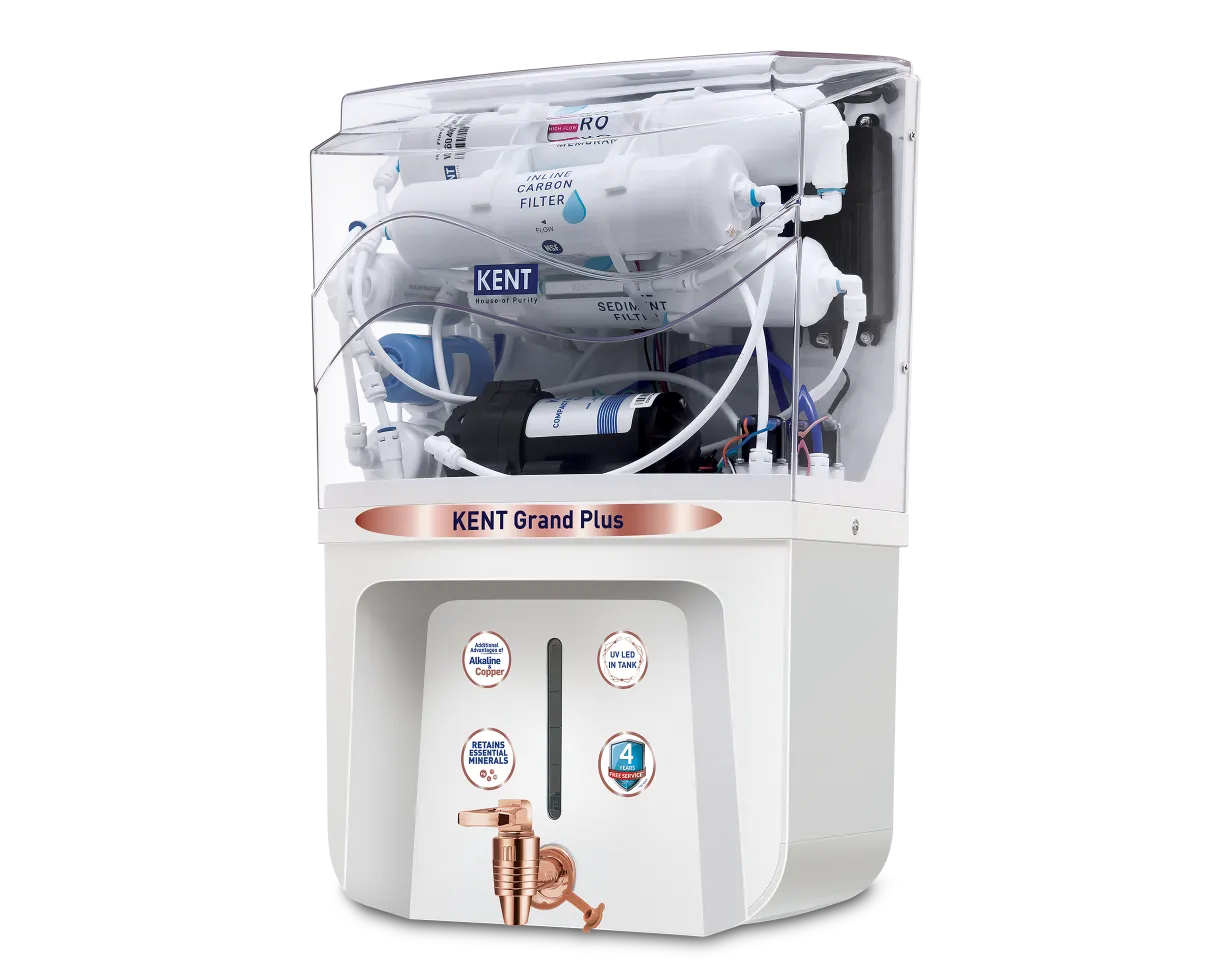
Families on borewell, tanker or high-TDS municipal supply who want the safest all-round choice.
View detailsLG
Hygiene-focused buyers, humid coastal cities, and anyone who has ever opened a purifier tank and been unpleasantly surprised.
View detailsAquaguard
Buyers who value service reliability and compact design over maximum tank capacity.
View detailsFree consultation · Pan-India
Tell us your city, your water source and your budget. For homes we will recommend the right technology — including telling you when a ₹3,000 purifier is genuinely enough. For offices, societies and factories, our team will size a system against your water report and send a specification-backed quotation.
Or email betterworkindia@gmail.com — attach a water analysis report and we can quote faster.
Homes
Right-sized recommendation for your TDS, not the most expensive unit
Offices & societies
25 LPH to 2,000+ LPH, sized on headcount and feed water
Industry
Pharma, food, textile, boiler feed — engineered to your specification
Service & AMC
Installation, repair and AMC with written response times