Skip to content

Water Quality · 16 topics

Water Quality: Purification, Softening, Consumables and Testing

India does not have one water problem, it has several, and they need different answers. Kochi's municipal supply runs around 100–400 ppm TDS and is soft; groundwater in Barmer can exceed 2,200 ppm and is brackish. Bengal and Assam sit in a documented arsenic belt; Rajasthan and Andhra have a fluoride problem. Ahmedabad and Jaipur are hard-water cities where scale, not contamination, is the daily complaint.

This is why generic advice fails so consistently. A purifier that is exactly right in Jodhpur is the wrong purchase in Thiruvananthapuram, where it would waste water and strip minerals to solve a problem that is not there — and a UV purifier that is perfectly adequate in Kerala offers no protection at all against the arsenic in a Bengal borewell.

This section covers the whole category: the three purification technologies and what each genuinely removes, the consumables that determine both cost and protection, softening for scale, commercial and industrial plants, and — most importantly — the measurement that should come before any of it.

Every water quality category, explained

Each page covers how the technology works, what it genuinely removes, what it costs to run, and where it stops.

Best water purifiers right now

Our tested and ranked picks, with prices and running costs.

AO Smith Z9 Green RO water purifier by AO Smith — product image
🏆 Best Premium / Best Hot Water

AO Smith Z9 Green RO

AO Smith

9.0/10
₹33,99019% off
  • RO + SCMT
  • 9 litres tank
  • Up to 3000 ppm TDS

Premium kitchens, high-TDS or brackish supply, and households that drink a lot of tea and coffee.

View details
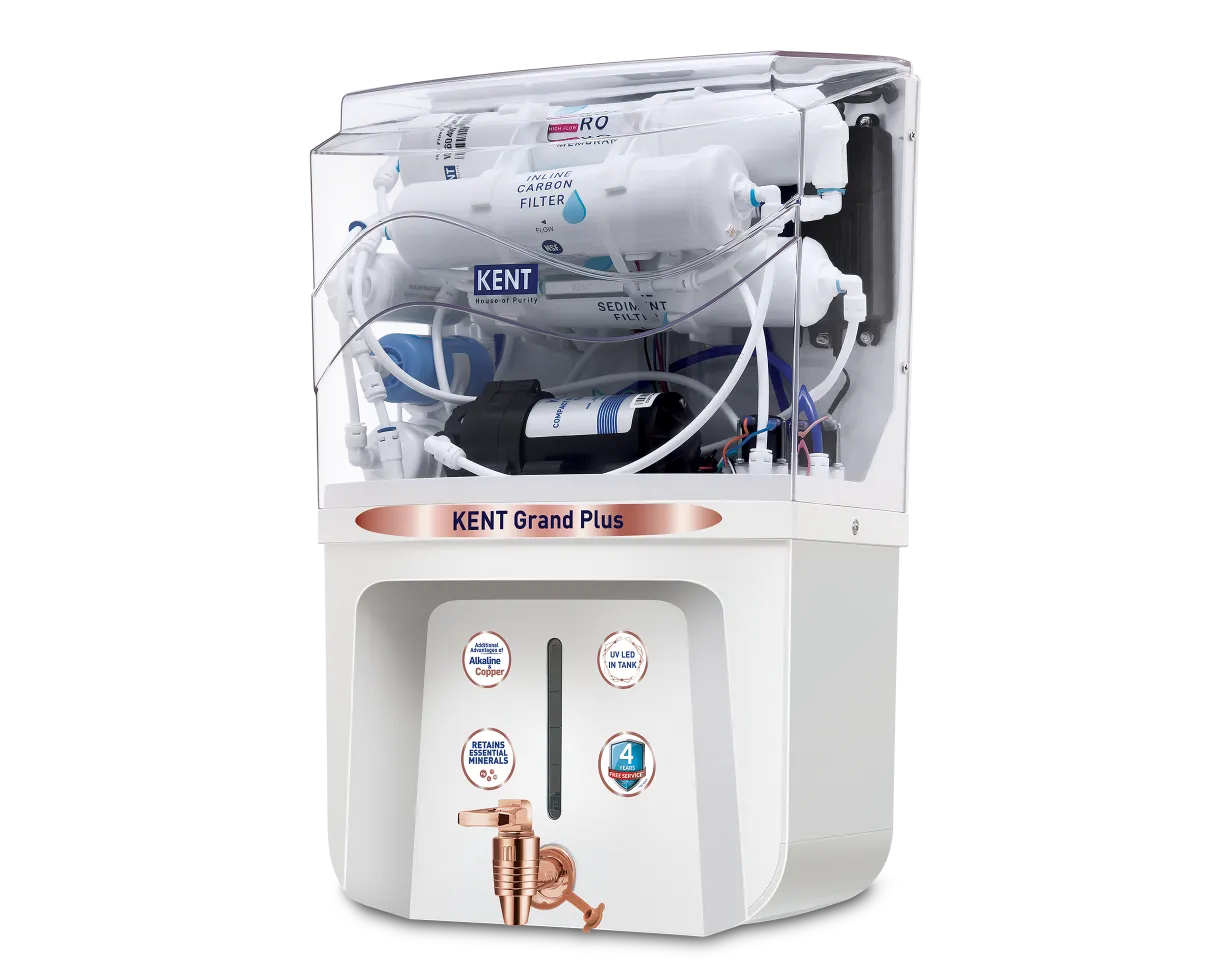
KENT Grand Plus water purifier by KENT — product image
🏆 Best Overall

KENT Grand Plus

KENT

8.9/10
₹16,49920% off
  • RO + UV + UF + TDS Controller
  • 9 litres tank
  • Up to 2000 ppm TDS

Families on borewell, tanker or high-TDS municipal supply who want the safest all-round choice.

View details
LG PuriCare WW182EP water purifier by LG — product image
🏆 Best Tank Hygiene

LG PuriCare WW182EP

LG

8.8/10
₹31,99018% off
  • RO + Dual Protection Sterilising Care UV
  • 8 litres tank
  • Up to 2000 ppm TDS

Hygiene-focused buyers, humid coastal cities, and anyone who has ever opened a purifier tank and been unpleasantly surprised.

View details
Aquaguard Delight NXT water purifier by Aquaguard — product image
🏆 Best Service Network

Aquaguard Delight NXT

Aquaguard

8.7/10
₹17,99023% off
  • RO + UV e-boiling + UF + MTDS + Active Copper
  • 6 litres tank
  • Up to 2000 ppm TDS

Buyers who value service reliability and compact design over maximum tank capacity.

View details

See the full ranking →

Shop by need

Understand it properly first

Frequently asked questions

How do I know which water purifier I need?
Measure your TDS with a ₹300 digital meter. Under 200 ppm, buy UV+UF — RO there wastes 2–3 litres per litre purified and strips useful minerals. Over 300 ppm, buy RO. Above 1,500 ppm, buy a 3,000 ppm-rated membrane and get a lab test. And buy RO regardless of the TDS reading if your area has any documented arsenic, fluoride or nitrate issue, because those are invisible to a TDS meter.
What is a safe TDS level for drinking water in India?
BIS IS 10500 sets 500 ppm as the acceptable limit and 2,000 ppm as the permissible maximum where no alternative source exists. For taste and mineral content, 50–150 ppm is ideal — target that as your purifier's output using a TDS controller. Below about 30 ppm water tastes flat and lacks useful calcium and magnesium.
Do I need a water softener as well as a purifier?
In a hard-water city, usually yes, because they solve different problems. A point-of-entry softener stops scale on geysers, taps, washing machines and bathroom fittings and improves laundry and bathing. A point-of-use RO handles drinking water. In Ahmedabad, Jaipur, Hyderabad, Indore or Jodhpur most homes eventually need both — a softener removes no contaminants and does not make water drinkable.
How much does water purifier maintenance cost per year?
Budget ₹2,500–₹4,500 a year for a domestic RO including all consumables and two to three service visits. The critical discipline is changing the cheap sediment and carbon pre-filters on schedule — an exhausted carbon filter lets chlorine reach the RO membrane and destroys it, turning a ₹400 saving into a ₹3,000 cost.
When should I get my water tested in a laboratory?
Before buying any purifier if you are on groundwater, before specifying any commercial system, annually if you use a borewell, and after any new borewell, flooding or local pipeline work. A NABL-accredited panel costs ₹1,500–₹3,500. If you are in an arsenic or fluoride belt, treat it as essential — a normal TDS reading is not reassurance in those regions.

Want a recommendation for your situation?

Tell us your city and what you are trying to solve. For homes we will point you at the right technology; for offices, societies and factories our team will size a system.

Free consultation · Pan-India

Not sure what you actually need? Ask us before you spend.

Tell us your city, your water source and your budget. For homes we will recommend the right technology — including telling you when a ₹3,000 purifier is genuinely enough. For offices, societies and factories, our team will size a system against your water report and send a specification-backed quotation.

Or email betterworkindia@gmail.com — attach a water analysis report and we can quote faster.

  • Homes

    Right-sized recommendation for your TDS, not the most expensive unit

  • Offices & societies

    25 LPH to 2,000+ LPH, sized on headcount and feed water

  • Industry

    Pharma, food, textile, boiler feed — engineered to your specification

  • Service & AMC

    Installation, repair and AMC with written response times

Pan-India installation & serviceAMC support availableFree site water-quality auditCustom-engineered to your TDSHow our quotation process works →