Skip to content

💧 Water technology · Head to head

RO vs UF Water Purifier: What Each One Can and Cannot Do

7 min read · Updated

RO (Reverse Osmosis)

A pressure-driven membrane at roughly 0.0001 microns that removes dissolved salts and metals along with everything larger.

UF (Ultrafiltration)

A hollow-fibre membrane at 0.01-0.1 microns that blocks bacteria, cysts and sediment using nothing but tap pressure.

Side by side

RO (Reverse Osmosis) compared with UF (Ultrafiltration)
ROUF
Pore size~0.0001 micron0.01-0.1 micron
Removes dissolved solids (TDS)Yes, 90-98%No
Removes hardness (calcium, magnesium)YesNo
Removes arsenic, fluoride, nitrate, leadYesNo
Blocks bacteria and cystsYesYes
Blocks virusesYesPartially — viruses are smaller than most UF pores
Removes sediment and turbidityYesYes — this is what it is best at
Needs electricityYesNo
Needs a drain connectionYesNo
Water wasted1-3 L per LNone
Works during a power cutNoYes
Typical price₹9,000-25,000₹2,000-8,000
Typical annual running cost₹3,000-5,000₹800-1,500
RO (Reverse Osmosis) compared with UF (Ultrafiltration)

Choose RO (Reverse Osmosis) if…

  • TDS above 300 ppm, or any groundwater source.
  • Water tastes salty, bitter or metallic.
  • Known arsenic, fluoride, nitrate or heavy-metal risk in your district.
  • Hard water leaving scale on utensils and geysers.
  • You want the widest possible safety margin and accept the running cost.

Choose UF (Ultrafiltration) if…

  • TDS under 200 ppm on treated municipal supply.
  • Frequent or long power cuts — UF keeps working when RO cannot.
  • You want zero water wastage, which matters in Bengaluru, Chennai and much of Maharashtra.
  • Sediment and turbidity after rain is your main complaint, not taste.
  • You are buying a second point-of-use filter for a bathroom, terrace tap or rented flat.

The size difference is the whole story

A UF membrane's pores are roughly 100 to 1,000 times larger than an RO membrane's. That sounds like a small engineering distinction; in practice it is the entire difference between the two products.

At 0.01 microns, UF is comfortably fine enough to stop bacteria (0.2-2 microns), Giardia and Cryptosporidium cysts (4-15 microns), silt, rust and colloidal matter. It is not remotely fine enough to stop a dissolved sodium ion, a calcium ion or an arsenite molecule, all of which pass through as if the membrane were not there. Nothing about a UF purifier's design can change that — it is physics, not a quality issue.

What UF is genuinely better at

  • Power cuts. A UF purifier is a passive device. If your area loses power for four hours in summer, your drinking water supply is unaffected.
  • Water wastage. RO discharges 1-3 litres per litre purified. UF discharges nothing. Over a year in a four-person household, that is 15,000-25,000 litres of difference.
  • Mineral retention. Calcium and magnesium in drinking water are a small but real dietary contribution, and RO removes them indiscriminately before a mineraliser adds a token amount back.
  • Running cost. A UF cartridge lasts 6-12 months and costs ₹600-1,200. There is no membrane to replace at ₹1,800 and no pump to fail.
  • Simplicity. Fewer parts, no drain line to route, no booster pump, and installation that does not require a plumber in most flats.

Where UF fails, and it fails hard

The failure mode is invisible, which is what makes it serious. A UF purifier fitted to 900 ppm borewell water produces clear, bacteria-free water that still contains every dissolved salt, every trace of fluoride and every microgram of arsenic that went in. It looks and tastes broadly like it did before. The household concludes the purifier works.

This is why UF-only purifiers should never be sold into groundwater-supplied areas, and why the honest framing of a gravity-based UF unit — the ₹2,000-4,000 non-electric category — is that it is a microbiological safety device for reasonably good municipal water, not a substitute for RO.

Important

If your supply is borewell, tanker-fed, coastal or seasonally brackish, UF alone is not a lower-budget version of RO. It is a different product that does not address your actual problem.

Why good RO purifiers include UF anyway

In an RO+UV+UF unit, the UF membrane is not competing with the RO membrane — it sits behind it as a physical barrier. If the RO membrane develops a pinhole, or the storage tank picks up contamination between services, UF catches the bacteria that UV would only inactivate rather than remove.

That redundancy is worth having, and it costs very little to add. It is also the one context in which the phrase 'more stages' on an Indian purifier box means something defensible.

Frequently asked questions

Is UF better than RO?
For low-TDS treated municipal water, arguably yes — UF needs no power, wastes no water, retains minerals and costs a fraction to run. For groundwater, high TDS or any chemical contamination concern it is not sufficient at all, because UF cannot remove anything dissolved.
Does UF remove TDS?
No. UF pores are around 0.01-0.1 microns, which is far too large to stop dissolved ions. TDS in equals TDS out. Only RO (and to a lesser extent distillation or deionisation) reduces TDS.
Can a UF purifier be used for borewell water?
No. Borewell supply typically carries high dissolved solids, hardness and frequently nitrate or heavy metals, none of which UF addresses. Borewell water needs RO, with UV behind it.
Does a UF water purifier need electricity?
No. UF works on ordinary tap or gravity pressure, which is why non-electric gravity purifiers use it. That makes it the sensible choice in areas with unreliable power, provided the water is low-TDS to begin with.
Which is cheaper, RO or UF?
UF, on both counts. A UF purifier costs ₹2,000-8,000 against ₹9,000-25,000 for RO, and roughly ₹800-1,500 a year to run against ₹3,000-5,000. The saving is only worth taking if UF actually treats your water adequately.

Still not sure which one your home needs?

Tell us your city and TDS reading and we will tell you which technology is actually required — including when the honest answer is the cheaper one.

Go deeper

Other comparisons like this

Our current top water purifiers

AO Smith Z9 Green RO water purifier by AO Smith — product image
🏆 Best Premium / Best Hot Water

AO Smith Z9 Green RO

AO Smith

9.0/10
₹33,99019% off
  • RO + SCMT
  • 9 litres tank
  • Up to 3000 ppm TDS

Premium kitchens, high-TDS or brackish supply, and households that drink a lot of tea and coffee.

View details
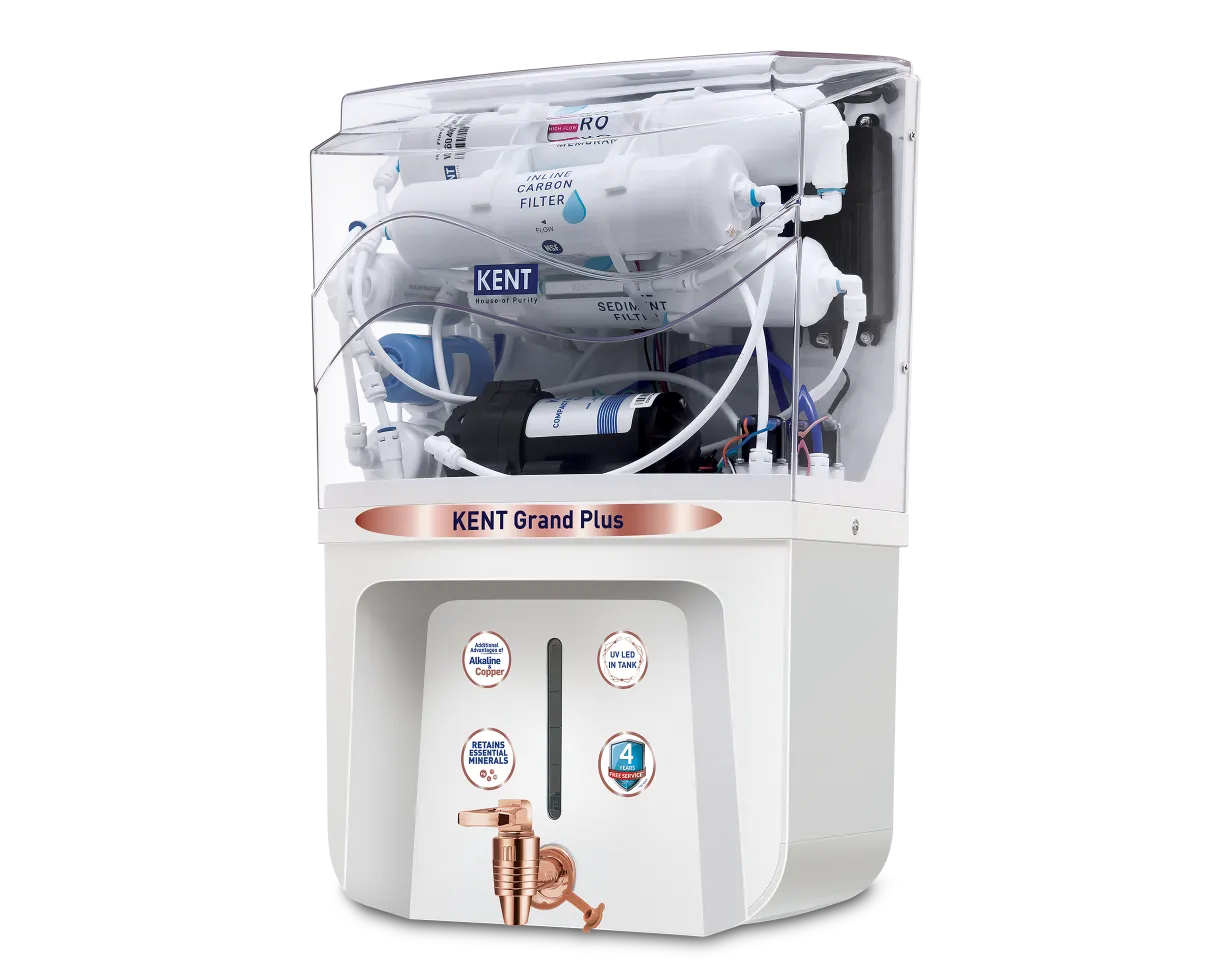
KENT Grand Plus water purifier by KENT — product image
🏆 Best Overall

KENT Grand Plus

KENT

8.9/10
₹16,49920% off
  • RO + UV + UF + TDS Controller
  • 9 litres tank
  • Up to 2000 ppm TDS

Families on borewell, tanker or high-TDS municipal supply who want the safest all-round choice.

View details
LG PuriCare WW182EP water purifier by LG — product image
🏆 Best Tank Hygiene

LG PuriCare WW182EP

LG

8.8/10
₹31,99018% off
  • RO + Dual Protection Sterilising Care UV
  • 8 litres tank
  • Up to 2000 ppm TDS

Hygiene-focused buyers, humid coastal cities, and anyone who has ever opened a purifier tank and been unpleasantly surprised.

View details
Aquaguard Delight NXT water purifier by Aquaguard — product image
🏆 Best Service Network

Aquaguard Delight NXT

Aquaguard

8.7/10
₹17,99023% off
  • RO + UV e-boiling + UF + MTDS + Active Copper
  • 6 litres tank
  • Up to 2000 ppm TDS

Buyers who value service reliability and compact design over maximum tank capacity.

View details

See the full ranking →

Free consultation · Pan-India

Not sure what you actually need? Ask us before you spend.

Tell us your city, your water source and your budget. For homes we will recommend the right technology — including telling you when a ₹3,000 purifier is genuinely enough. For offices, societies and factories, our team will size a system against your water report and send a specification-backed quotation.

Or email betterworkindia@gmail.com — attach a water analysis report and we can quote faster.

  • Homes

    Right-sized recommendation for your TDS, not the most expensive unit

  • Offices & societies

    25 LPH to 2,000+ LPH, sized on headcount and feed water

  • Industry

    Pharma, food, textile, boiler feed — engineered to your specification

  • Service & AMC

    Installation, repair and AMC with written response times

Pan-India installation & serviceAMC support availableFree site water-quality auditCustom-engineered to your TDSHow our quotation process works →