💧 Water purifier guide
RO vs UV vs UF: Which Water Purifier Do You Actually Need?
The one-line version
RO removes what is dissolved in water. UV kills what is alive in water. UF filters out what is floating in water. They solve three different problems, which is why the right answer depends entirely on which problem you actually have.
Almost every purifier sold in India bundles two or three of these together, and salespeople tend to present more stages as unambiguously better. It is not that simple — buying RO for genuinely soft, treated municipal water wastes money, wastes two to three litres of water per litre purified, and strips out calcium and magnesium you would rather keep.
How each technology actually works
| RO | UV | UF | |
|---|---|---|---|
| Mechanism | Semi-permeable membrane under pressure | UV-C light damages microbial DNA | Hollow-fibre membrane, 0.01-0.1 micron |
| Removes TDS / dissolved salts | Yes (90-98%) | No | No |
| Removes heavy metals, arsenic, fluoride | Yes | No | No |
| Kills bacteria and viruses | Yes (physical barrier) | Yes (inactivates) | Blocks bacteria and cysts; less effective on viruses |
| Needs electricity | Yes | Yes | No |
| Wastes water | Yes, 1-3 L per L purified | No | Minimal |
| Retains minerals | No (needs a TDS controller to blend back) | Yes | Yes |
| Typical running cost | Highest | Moderate | Lowest |
The decision rule, in order
- Step 1 — Measure your TDS with a digital meter (~₹300). Do it in both summer and monsoon if your supply changes seasonally.
- Step 2 — Check whether your area has a documented arsenic, fluoride or nitrate issue. If yes, buy RO regardless of what the TDS says. These contaminants are invisible, tasteless, and can be present at normal TDS.
- Step 3 — TDS below 200 ppm and no contaminant concern → buy UV+UF. You will spend less, waste no water and keep your minerals.
- Step 4 — TDS 200-300 ppm → either works. UV+UF is the more economical and environmentally sensible choice.
- Step 5 — TDS above 300 ppm → buy RO with UV behind it, and insist on a TDS controller.
- Step 6 — Borewell, tanker or unknown source → buy RO+UV and design for the worst reading you have measured, not the average.
Important
Why 'more stages' is not the answer
Stage counts are the most inflated number in this industry. Brands routinely count a sediment pad, a post-carbon polisher and a mineral cartridge as three separate 'purification stages' to reach a headline figure of 9, 10 or 12.
Ignore the count entirely. Read the specification and confirm which of these are genuinely present: an RO membrane, a UV lamp, a UF membrane, and a TDS controller. A well-built 6-stage purifier from a brand that services your city will outperform a 12-stage unit from one that does not.
Frequently asked questions
Which is better, RO or UV water purifier?
Can I use a UV purifier for borewell water?
Is UF better than RO?
Still not sure which water purifier fits?
Tell us your city and situation. We will give you a straight answer — including when the honest answer is that you do not need to spend much at all.
Shortlists that follow this advice
Read next
Our current top water purifiers

AO Smith Z9 Green RO
AO Smith
- RO + SCMT
- 9 litres tank
- Up to 3000 ppm TDS
Premium kitchens, high-TDS or brackish supply, and households that drink a lot of tea and coffee.
View details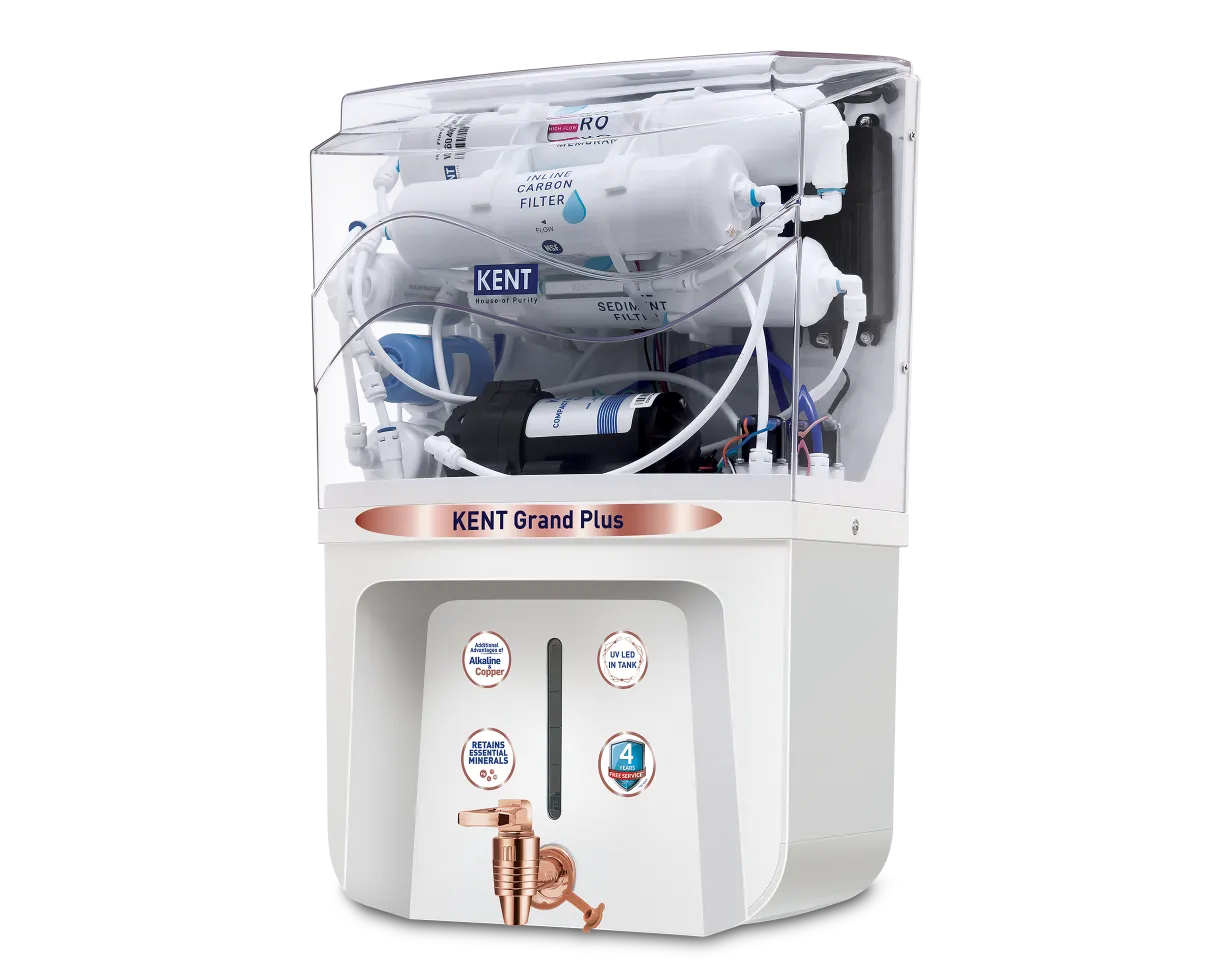
KENT Grand Plus
KENT
- RO + UV + UF + TDS Controller
- 9 litres tank
- Up to 2000 ppm TDS
Families on borewell, tanker or high-TDS municipal supply who want the safest all-round choice.
View details
LG PuriCare WW182EP
LG
- RO + Dual Protection Sterilising Care UV
- 8 litres tank
- Up to 2000 ppm TDS
Hygiene-focused buyers, humid coastal cities, and anyone who has ever opened a purifier tank and been unpleasantly surprised.
View details
Aquaguard Delight NXT
Aquaguard
- RO + UV e-boiling + UF + MTDS + Active Copper
- 6 litres tank
- Up to 2000 ppm TDS
Buyers who value service reliability and compact design over maximum tank capacity.
View details