Skip to content

Water Quality

UF Water Purifiers: Ultrafiltration, and Why It Needs No Electricity

Ultrafiltration is the quiet workhorse of Indian water purification. A UF membrane is a bundle of hollow fibres with microscopic pores, typically 0.01 to 0.1 micron. Water passes through the fibre walls; anything larger than the pores does not. Bacteria are around 0.5–5 microns and protozoan cysts larger still, so both are physically excluded.

Two consequences follow, and they are the reason UF matters. First, because the mechanism is size exclusion rather than pressure-driven ion rejection, gravity alone provides enough driving force — so a UF purifier can work with no electricity, no pump and no plumbing. Second, because the pores are far larger than a dissolved ion, minerals pass straight through, so the water is not demineralised.

For a very large number of Indian households on treated municipal supply, that combination is exactly right — and considerably cheaper than what they are usually sold.

What UF blocks, at a glance

ContaminantTypical sizeBlocked by UF (0.01–0.1 µm)?
Suspended solids, silt> 1 µmYes
Protozoan cysts (Giardia, Crypto)4–15 µmYes
Bacteria (E. coli, Vibrio)0.5–5 µmYes
Most viruses0.02–0.3 µmPartially — smaller viruses can pass
Colloids and some organics0.01–1 µmPartially
Dissolved salts / TDS< 0.001 µmNo
Arsenic, fluoride, nitrate (dissolved)< 0.001 µmNo
Hardness ions< 0.001 µmNo

Note

Because smaller viruses can pass a UF membrane, the best low-TDS configuration is UV + UF rather than UF alone: UF is the physical fail-safe, UV handles what gets through.

Why UF needs no electricity

Reverse osmosis has to overcome osmotic pressure — the natural tendency of water to move toward higher salt concentration — which requires a pump generating substantial pressure. Ultrafiltration is not fighting osmosis at all; it is simply straining. A metre of water head is sufficient driving force.

That is the entire basis of the gravity purifier: an upper chamber, a UF cartridge, a lower chamber and a tap. No pump, no power, no drain line, no reject water. In a country with intermittent electricity and many homes without a pressurised supply, this is a genuinely important piece of engineering.

Where UF is the right choice

  • Treated municipal supply below roughly 200 ppm TDS, where the real risk is post-treatment contamination in pipes and building tanks.
  • Kerala, coastal Karnataka, Himachal, the North East, Srinagar and much of piped Mumbai — soft, low-TDS supply where RO is actively counterproductive.
  • Homes with unreliable power, where an electric purifier is unavailable exactly when you need water.
  • Hostels, rented rooms and site offices where nothing can be installed permanently.
  • As a backup barrier alongside RO and UV in a multi-stage purifier — which is why good units include all three.
  • Second homes and holiday properties that sit unused for long periods.

Where UF is not enough

  • Any borewell, tanker or brackish supply — UF removes no TDS.
  • Anywhere with documented arsenic, fluoride or nitrate in groundwater. UF offers no protection against dissolved contaminants.
  • Water with heavy iron, which will foul the fibres.
  • Very turbid raw water without adequate pre-filtration — the membrane clogs quickly.
  • As the only barrier where virus risk is a specific concern; add UV.

Maintenance

  • UF membrane life is typically 24–36 months in domestic use, longer than an RO membrane because it is under far less stress.
  • Backwash if the unit supports it — many gravity models have a flush facility that clears the fibre surface and extends life significantly.
  • Flow rate falling off is the normal end-of-life signal.
  • Replace the sediment pre-filter on schedule; it does most of the work protecting the UF cartridge.
  • Never let a UF cartridge dry out completely between uses if the manufacturer advises against it — some fibres are damaged by drying.

Our tested picks in this category

Ranked on our editorial score. Full reviews, running costs and buy links on each.

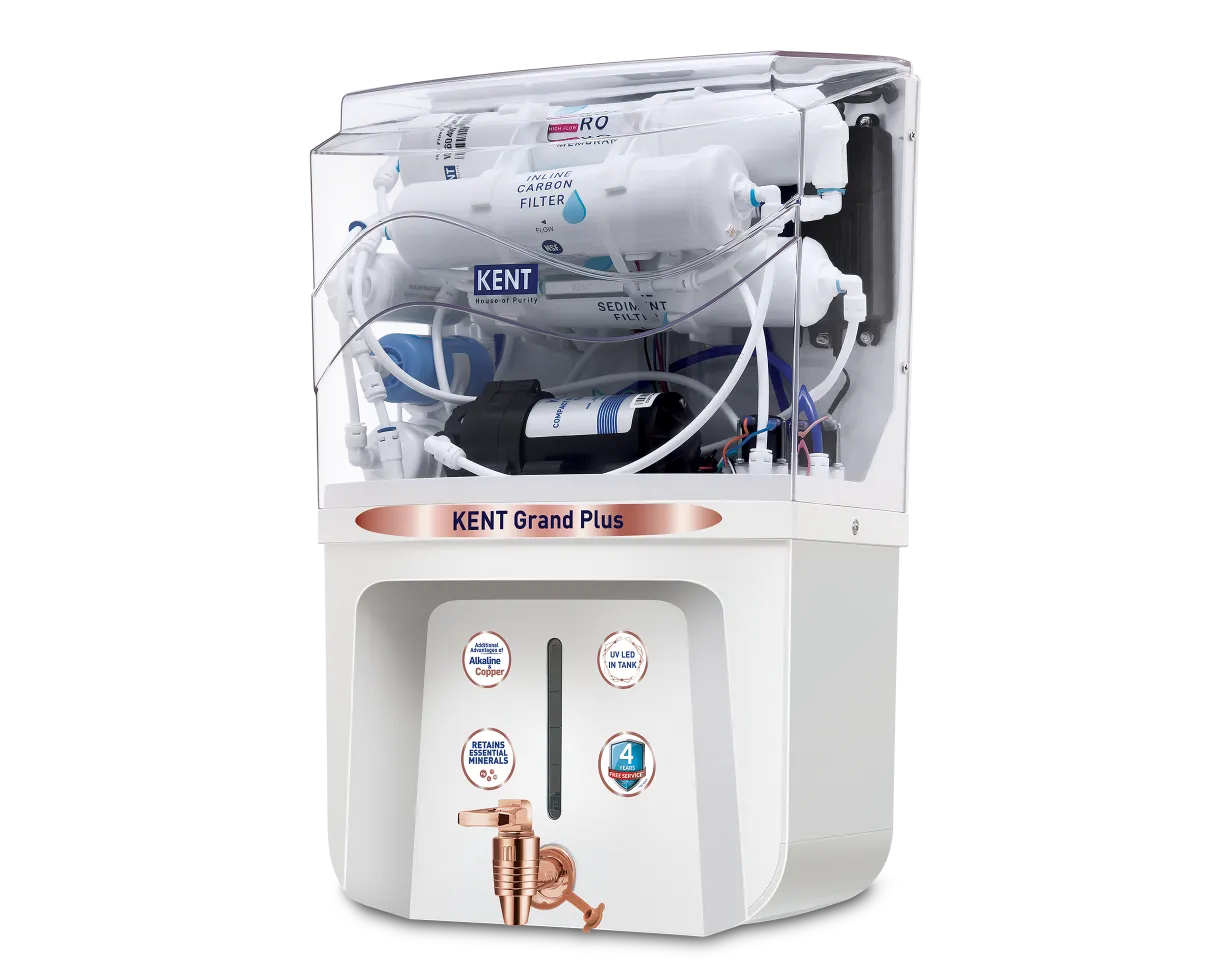
KENT Grand Plus water purifier by KENT — product image
🏆 Best Overall

KENT Grand Plus

by KENT

8.9/10our editorial score
₹16,499M.R.P. ₹20,50020% off

Indicative price, verified 2026-08-01. Confirm on the marketplace before buying.

Running cost: ₹3,500/year in filters & servicing

  • RO + UV + UF + TDS Controller
  • 9 litres tank
  • Up to 2000 ppm TDS
  • TDS controller
  • High water recovery

If someone asks for one water purifier recommendation without telling me anything about their water, this is the answer. The Grand Plus is not the prettiest or the cheapest unit in this list, but it is the most consistently correct one: an RO membrane rated to 2,000 ppm input, UV and UF stages behind it, and a TDS controller so that low-TDS supply does not get stripped to tasteless.


Aquaguard Delight NXT water purifier by Aquaguard — product image
🏆 Best Service Network

Aquaguard Delight NXT

by Aquaguard

8.7/10our editorial score
₹17,990M.R.P. ₹23,50023% off

Indicative price, verified 2026-08-01. Confirm on the marketplace before buying.

Running cost: ₹4,200/year in filters & servicing

  • RO + UV e-boiling + UF + MTDS + Active Copper
  • 6 litres tank
  • Up to 2000 ppm TDS
  • Copper
  • TDS controller

The Delight NXT is what I recommend to people who have been burned by bad service. Purification-wise it is closely matched with the KENT Grand Plus — same 2,000 ppm ceiling, same core stages — so the decision comes down to two things: tank size and who shows up when it breaks. KENT gives you 9 litres; Aquaguard gives you 6 litres and Eureka Forbes' direct field force, which in my experience is the most dependable in Indian appliances.

Aquaguard Aura water purifier by Aquaguard — product image

Aquaguard Aura

by Aquaguard

8.5/10our editorial score
₹25,490M.R.P. ₹32,00020% off

Indicative price, verified 2026-08-01. Confirm on the marketplace before buying.

Running cost: ₹5,200/year in filters & servicing

  • RO + UV e-boiling + UF + MTDS + Active Copper + Alkaline
  • 7 litres tank
  • Up to 2000 ppm TDS
  • Copper
  • Alkaline

The Aura is Aquaguard's answer to the wellness-feature arms race, and it executes it better than most: the copper and alkaline stages are both switchable, so you are not locked into either. Underneath, the purification is the same reliable 2,000 ppm RO+UV+UF stack as the Delight NXT, with a slightly larger tank and faster throughput.

KENT Pearl RO water purifier by KENT — product image

KENT Pearl RO

by KENT

8.4/10our editorial score
₹17,990M.R.P. ₹22,00018% off

Indicative price, verified 2026-08-01. Confirm on the marketplace before buying.

Running cost: ₹3,600/year in filters & servicing

  • RO + UV + UF + TDS Controller
  • 8 litres tank
  • Up to 2000 ppm TDS
  • TDS controller

The Pearl is the Grand Plus's engineering in a counter-top body, plus one genuinely valuable addition: a UV lamp inside the storage tank. Most purifiers sterilise water on the way in and then let it sit in a warm plastic tank for hours, which is exactly how biofilm forms. Keeping the tank itself under UV is the right answer to a real problem, particularly in humid coastal cities.

Pureit Copper+ RO water purifier by Pureit — product image
🏆 Safest Filter-Life Enforcement

Pureit Copper+ RO

by Pureit

8.4/10our editorial score
₹15,999M.R.P. ₹22,00027% off

Indicative price, verified 2026-08-01. Confirm on the marketplace before buying.

Running cost: ₹3,800/year in filters & servicing

  • RO + UV + MF + Copper Charge technology
  • 8 litres tank
  • Up to 2000 ppm TDS
  • Copper
  • TDS controller

Pureit's defining design decision is the one most buyers complain about and I think is exactly right: when the germkill kit reaches the end of its rated life, the purifier stops dispensing. Not a beep, not a blinking light you learn to ignore — it stops. Every other brand relies on you noticing an indicator, and in practice most Indian households run filters months past their rated life, which quietly turns a purifier into a contamination source.

Frequently asked questions

What is the difference between UF and RO?
Pore size and mechanism. UF membranes have pores of 0.01–0.1 micron and work by size exclusion, blocking bacteria, cysts and solids while letting dissolved minerals through — so UF does not reduce TDS and needs no pump. RO membranes are effectively non-porous and reject dissolved ions under high pressure, so RO lowers TDS but needs electricity and produces reject water.
Does a UF purifier remove bacteria?
Yes. Bacteria are roughly 0.5–5 microns and protozoan cysts larger still, both far bigger than a UF membrane's 0.01–0.1 micron pores, so they are physically excluded. Smaller viruses can pass, which is why UV+UF is the stronger configuration where virus risk matters.
Is a UF water purifier enough for my home?
It is, if your supply is treated municipal water below about 200 ppm TDS with no known arsenic, fluoride or nitrate issue. In that situation UF (ideally with UV) addresses your actual risk while retaining minerals and wasting no water. It is not enough for borewell, tanker or brackish supply, where you need RO.
How long does a UF membrane last?
Typically 24–36 months in domestic use — longer than an RO membrane, because it operates at low pressure and is less stressed. Falling flow rate is the usual end-of-life signal. Changing the sediment pre-filter on schedule and using the backwash function where fitted both extend life considerably.

Go deeper on this site

Related water quality topics

Free consultation · Pan-India

Not sure what you actually need? Ask us before you spend.

Tell us your city, your water source and your budget. For homes we will recommend the right technology — including telling you when a ₹3,000 purifier is genuinely enough. For offices, societies and factories, our team will size a system against your water report and send a specification-backed quotation.

Or email betterworkindia@gmail.com — attach a water analysis report and we can quote faster.

  • Homes

    Right-sized recommendation for your TDS, not the most expensive unit

  • Offices & societies

    25 LPH to 2,000+ LPH, sized on headcount and feed water

  • Industry

    Pharma, food, textile, boiler feed — engineered to your specification

  • Service & AMC

    Installation, repair and AMC with written response times

Pan-India installation & serviceAMC support availableFree site water-quality auditCustom-engineered to your TDSHow our quotation process works →