
Skip to content

Water Quality

RO Water Purifiers: How Reverse Osmosis Works, and When You Need It

Reverse osmosis works by pressure. A pump pushes water against a semi-permeable membrane whose pores are small enough to pass water molecules but reject most dissolved ions, and the rejected concentrate is carried away as reject water. That mechanism is why RO can remove things no filter can: dissolved salts, heavy metals, fluoride, nitrate and arsenic are all ions in solution, invisible to any physical filter.

It is genuinely the right answer for a very large share of Indian households — anyone on borewell, tanker or brackish supply, and anyone in the documented arsenic or fluoride belts. It is also, just as genuinely, the wrong answer for a substantial minority, and almost nobody selling purifiers will tell you which group you are in.

The deciding number is your TDS, and it costs ₹300 to find out.

What RO removes — and what it does not

ContaminantRO effectivenessNote
Dissolved salts / TDS90–98%The defining capability. No other domestic technology does this.
ArsenicTypically 90–98%Critical in the Ganga–Brahmaputra belt. UV and UF remove none.
FluorideHighCritical in Rajasthan, Gujarat, AP and Telangana fluoride belts.
Lead, chromium, cadmiumHighRelevant near industrial and tannery clusters.
NitrateHighCommon in intensively farmed groundwater.
Hardness (Ca, Mg)HighFor drinking water only — not whole-house scale.
Bacteria & virusesHigh as a physical barrierBut pair with UV: a pinhole or bypass passes live organisms.
ChlorineRemoved by the carbon pre-filterMust be, or chlorine destroys the membrane.
Dissolved gasesPoorlySome gases pass through; usually not a health concern.

The TDS decision — should you buy RO at all?

Your TDSCorrect choiceReasoning
Under 200 ppmUV + UF, not RORO wastes 2–3 L per litre, strips useful minerals, costs more to run
200 – 300 ppmEither; UV+UF preferredThe economical and water-efficient choice at this level
300 – 700 ppmRO + UV + UF with TDS controllerStandard 2,000 ppm membrane is ample
700 – 1,500 ppmRO rated 2,000 ppmExpect membrane replacement every 10–12 months
Above 1,500 ppmRO rated 3,000 ppm + lab testBrackish; often also has hardness or fluoride needing pre-treatment
Any known arsenic/fluoride areaRO regardless of TDSThese are invisible at normal TDS readings

Important

TDS is a bulk measure, not a safety verdict. Water at 120 ppm can contain dangerous arsenic and read as excellent. Use TDS to choose technology; use a NABL-accredited laboratory test to establish whether your water is safe.

Water wastage — the honest numbers

A conventional domestic RO rejects roughly 3 litres for every litre it purifies. For a family purifying 15 litres a day that is about 45 litres daily and over 16,000 litres a year. In a city where you buy tanker water, that is a line on your monthly bill rather than an abstraction.

'Zero waste RO' is an overstatement: reverse osmosis physically requires a concentrate stream, because the whole mechanism depends on carrying rejected salts away from the membrane. What genuinely exists is high-recovery RO, which recirculates reject water to reach roughly 50% recovery instead of 25%. KENT's Save Water technology and AO Smith's Advanced Recovery Technology are the two most substantive implementations.

The other half of the answer costs nothing: run the reject line into a bucket and use it for mopping, flushing and washing vehicles. Avoid using it on plants if your input water is hard, because the concentrated salts accumulate in soil.

Membrane life and what shortens it

  • Typical domestic membrane life is 12–24 months, but 10–12 months above roughly 1,200 ppm input.
  • Chlorine is the main killer. An exhausted carbon pre-filter lets chlorine reach the membrane and chemically destroys the thin-film polyamide layer — turning a ₹400 saving into a ₹3,000 replacement.
  • Sediment abrades the membrane surface, which is what the sediment pre-filter prevents.
  • Iron fouls membranes rapidly. If your water leaves orange staining, you need iron removal upstream, not a bigger RO.
  • Hardness scales the membrane. Above roughly 2,000 ppm, antiscalant dosing ahead of the membrane becomes appropriate.
  • Running dry or at inadequate inlet pressure stresses both pump and membrane.

Prices and options

BudgetWhat you getSuits
₹8,000 – ₹12,000Basic RO + UV, no TDS controllerHigh-TDS supply on a tight budget
₹12,000 – ₹16,000RO + UV + UF, TDS controller, 7 L tankMost households — the value band
₹16,000 – ₹21,0002,000 ppm rated, 8–9 L tank, high recoveryBorewell and tanker supply — the sweet spot
₹21,000 – ₹28,000Copper/alkaline, under-sink, better buildFeature-led buyers
₹28,000 – ₹38,0003,000 ppm rated, hot water, steel tankBrackish water, or hot-water-on-tap

Indicative Indian market ranges for budgeting, not quotations. Prices move frequently — always confirm on the marketplace or with a supplier before purchasing.

Our tested picks in this category

Ranked on our editorial score. Full reviews, running costs and buy links on each.

AO Smith Z9 Green RO water purifier by AO Smith — product image
🏆 Best Premium / Best Hot Water

AO Smith Z9 Green RO

by AO Smith

9.0/10our editorial score
₹33,990M.R.P. ₹42,00019% off

Indicative price, verified 2026-08-01. Confirm on the marketplace before buying.

Running cost: ₹4,500/year in filters & servicing

  • RO + SCMT
  • 9 litres tank
  • Up to 3000 ppm TDS
  • Hot water
  • TDS controller

The Z9 is the best domestic water purifier sold in India, and I say that fully aware of the price. Three things justify it. First, the 3,000 ppm input rating — nothing else mainstream goes that high, and in Jodhpur, Bikaner, Agra or coastal Chennai that headroom is the difference between a membrane that lasts a year and one that dies in five months. Second, Advanced Recovery Technology, which is the most substantive water-saving engineering in the category rather than a sticker. Third, the hot water: 45°C, 80°C and 100°C on demand, properly child-locked, which quietly eliminates the kettle from your counter.
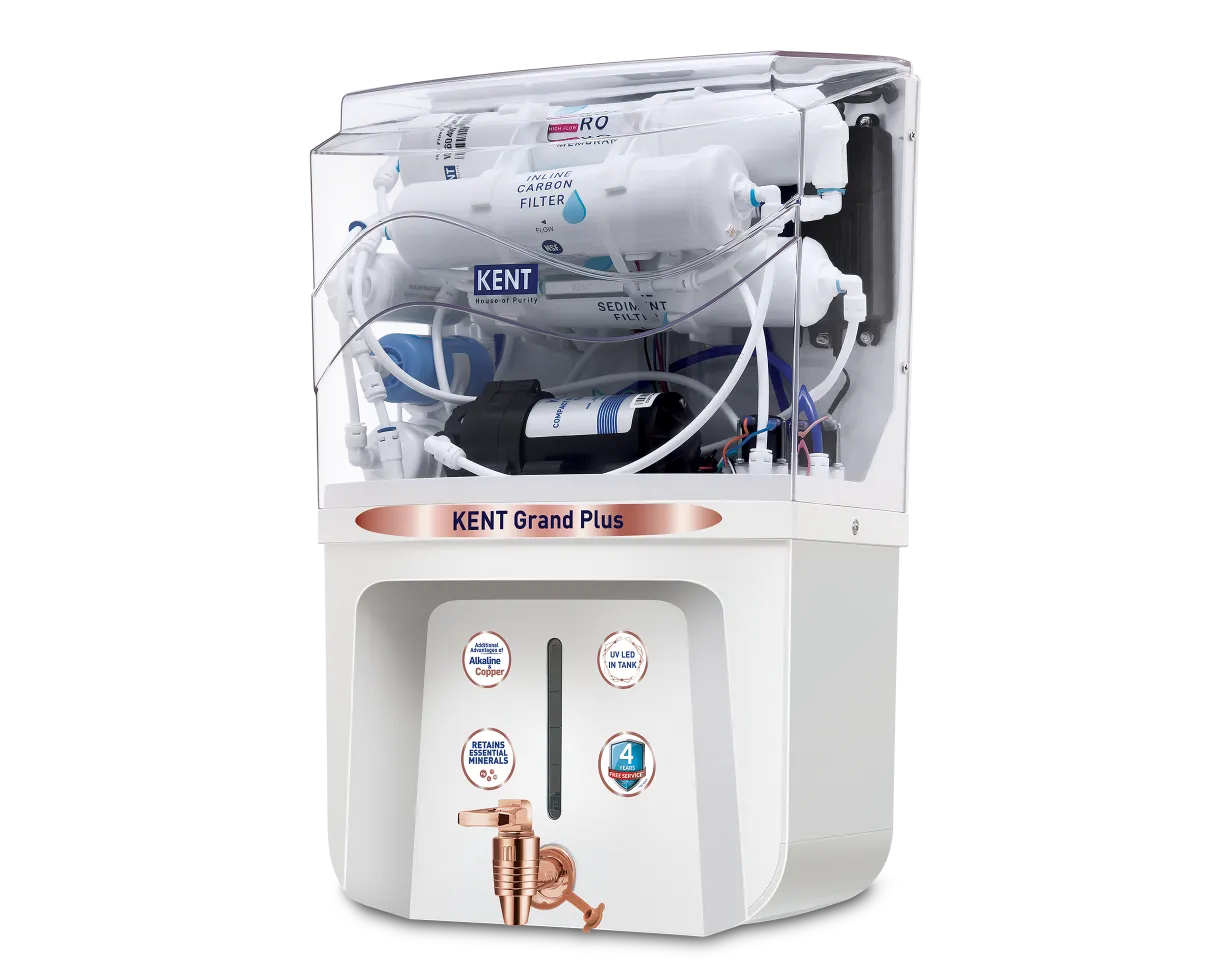

KENT Grand Plus water purifier by KENT — product image
🏆 Best Overall

KENT Grand Plus

by KENT

8.9/10our editorial score
₹16,499M.R.P. ₹20,50020% off

Indicative price, verified 2026-08-01. Confirm on the marketplace before buying.

Running cost: ₹3,500/year in filters & servicing

  • RO + UV + UF + TDS Controller
  • 9 litres tank
  • Up to 2000 ppm TDS
  • TDS controller
  • High water recovery

If someone asks for one water purifier recommendation without telling me anything about their water, this is the answer. The Grand Plus is not the prettiest or the cheapest unit in this list, but it is the most consistently correct one: an RO membrane rated to 2,000 ppm input, UV and UF stages behind it, and a TDS controller so that low-TDS supply does not get stripped to tasteless.

LG PuriCare WW182EP water purifier by LG — product image
🏆 Best Tank Hygiene

LG PuriCare WW182EP

by LG

8.8/10our editorial score
₹31,990M.R.P. ₹39,00018% off

Indicative price, verified 2026-08-01. Confirm on the marketplace before buying.

Running cost: ₹4,400/year in filters & servicing

  • RO + Dual Protection Sterilising Care UV
  • 8 litres tank
  • Up to 2000 ppm TDS

Almost every purifier sold in India stores purified water in a sealed plastic tank at room temperature for hours at a time. In a Chennai or Kochi summer, that is an excellent environment for biofilm, and it is the failure mode nobody markets against. LG's answer is the right one on both counts: a stainless-steel tank that resists colonisation, and an automatic UV cycle that sterilises the tank and the outlet tap every couple of hours whether you remember to think about it or not.

Aquaguard Delight NXT water purifier by Aquaguard — product image
🏆 Best Service Network

Aquaguard Delight NXT

by Aquaguard

8.7/10our editorial score
₹17,990M.R.P. ₹23,50023% off

Indicative price, verified 2026-08-01. Confirm on the marketplace before buying.

Running cost: ₹4,200/year in filters & servicing

  • RO + UV e-boiling + UF + MTDS + Active Copper
  • 6 litres tank
  • Up to 2000 ppm TDS
  • Copper
  • TDS controller

The Delight NXT is what I recommend to people who have been burned by bad service. Purification-wise it is closely matched with the KENT Grand Plus — same 2,000 ppm ceiling, same core stages — so the decision comes down to two things: tank size and who shows up when it breaks. KENT gives you 9 litres; Aquaguard gives you 6 litres and Eureka Forbes' direct field force, which in my experience is the most dependable in Indian appliances.

AO Smith X7 water purifier by AO Smith — product image

AO Smith X7

by AO Smith

8.6/10our editorial score
₹23,490M.R.P. ₹30,00022% off

Indicative price, verified 2026-08-01. Confirm on the marketplace before buying.

Running cost: ₹4,000/year in filters & servicing

  • RO + SCMT + Mineraliser, 8-stage
  • 7 litres tank
  • Up to 2000 ppm TDS
  • TDS controller
  • High water recovery

The X7 is the smart-money AO Smith. You keep the build quality, the silver-charged membrane and — crucially — Advanced Recovery Technology, which is the brand's genuine engineering advantage. You give up hot water and drop from a 3,000 ppm to a 2,000 ppm input rating, which still covers the overwhelming majority of Indian supply.

Frequently asked questions

Is RO water safe to drink long term?
Yes, provided you keep output at a sensible 60–120 ppm using the TDS controller and maintain the filters. The mineral-loss concern is real but modest, because food supplies most of your calcium and magnesium. Drinking near-zero-TDS water long term is not advisable — but that is a settings issue, not a problem with RO. Where supply is high-TDS or in an arsenic or fluoride belt, the risk of not using RO is far greater.
How much water does an RO purifier waste?
A conventional domestic RO rejects about 3 litres per litre purified — roughly 16,000 litres a year for a typical family. High-recovery designs such as KENT's Save Water technology or AO Smith's Advanced Recovery Technology bring that closer to 1:1. Plumbing the reject line into a bucket for mopping and flushing recovers most of the rest.
Do I need RO if my water is already treated municipal supply?
Often not. If treated supply tests below 200 ppm TDS and your area has no documented arsenic, fluoride or nitrate issue, a UV+UF purifier addresses your real risk — microbiological contamination from old pipes and building tanks — while retaining minerals and wasting no water. Buy RO if TDS exceeds 300 ppm, if supply is blended with borewell water, or if any dissolved-contaminant concern exists.
What TDS should RO output be?
Aim for 60–120 ppm. Below about 40 ppm the water tastes flat and lacks useful calcium and magnesium; the WHO has published on the drawbacks of fully demineralised drinking water. Use the TDS controller to blend back to the pleasant range, and measure output with a meter rather than assuming.

Go deeper on this site

Related water quality topics

Free consultation · Pan-India

Not sure what you actually need? Ask us before you spend.

Tell us your city, your water source and your budget. For homes we will recommend the right technology — including telling you when a ₹3,000 purifier is genuinely enough. For offices, societies and factories, our team will size a system against your water report and send a specification-backed quotation.

Or email betterworkindia@gmail.com — attach a water analysis report and we can quote faster.

  • Homes

    Right-sized recommendation for your TDS, not the most expensive unit

  • Offices & societies

    25 LPH to 2,000+ LPH, sized on headcount and feed water

  • Industry

    Pharma, food, textile, boiler feed — engineered to your specification

  • Service & AMC

    Installation, repair and AMC with written response times

Pan-India installation & serviceAMC support availableFree site water-quality auditCustom-engineered to your TDSHow our quotation process works →