
Skip to content

Water Quality

Water Filters: Types, What They Remove, and Where They Stop

'Water filter' covers a much wider and vaguer range of products than 'water purifier', and the imprecision is where buyers get into trouble. A ₹300 ceramic candle and a ₹25,000 RO unit are both sold as ways to clean water, and they are not remotely comparable.

The useful distinction is mechanism. A filter strains: it physically excludes particles larger than its pore size and, if it contains activated carbon, adsorbs some chemicals. A purifier goes further, either inactivating microbes with UV or rejecting dissolved ions with an RO membrane.

That difference determines what each is safe for — and there is one rule that applies across the whole category: no filter reduces TDS.

Filter types compared

TypeRemovesDoes NOT removeTypical price
Sediment / spun filterSilt, sand, rust, suspended solidsBacteria, TDS, chemicals₹150 – ₹400
Ceramic candleSediment, most bacteria, cystsViruses (unreliable), TDS, arsenic, fluoride₹200 – ₹800
Activated carbon blockChlorine, taste, odour, some organicsTDS, bacteria, hardness₹250 – ₹900
Filter jug (carbon + ion exchange)Chlorine taste, limescale, some metalsBacteria, viruses, TDS meaningfully₹2,000 – ₹3,500
Ion-exchange jug (ZeroWater type)TDS to near zeroNot a validated microbiological barrier₹4,000 – ₹5,500
Gravity UF purifierBacteria, cysts, sedimentTDS, arsenic, fluoride₹1,400 – ₹3,000
Inline / under-sink filterSediment, chlorine (per media)TDS, bacteria unless UV/UF added₹800 – ₹3,000
Whole-house sediment filterSilt and rust for the whole homeTDS, hardness, bacteria₹3,000 – ₹15,000

The candle filter question

Ceramic candle filters are among the most widely sold and most widely misunderstood water products in India. A good ceramic candle has pore sizes fine enough to exclude most bacteria and protozoan cysts, and some are impregnated with silver to inhibit growth within the candle itself. Used on reasonably clear municipal water, they are not useless.

But they do not reliably remove viruses, which are smaller than typical ceramic pore sizes, and they remove nothing dissolved — no TDS, no arsenic, no fluoride, no nitrate. A candle filter on borewell water in a fluoride belt provides false confidence and no protection against the contaminant that matters.

Important

Candles crack, and a cracked candle passes everything while looking intact. Inspect regularly, scrub the surface gently rather than aggressively, and replace on schedule rather than waiting for a visible problem.

Filter jugs — useful, and frequently misrepresented

  • A standard carbon-plus-ion-exchange jug (Brita and similar) genuinely improves chlorine taste and odour and reduces limescale. That is worth having if your water is already safe.
  • It is not a microbiological barrier. Never use one as your only protection for water of uncertain quality.
  • It does not meaningfully reduce TDS. Water at 600 ppm remains brackish.
  • Ion-exchange jugs such as ZeroWater genuinely do reduce TDS to near zero, and ship with a meter so you can verify it — but cartridge life collapses on high-TDS Indian water, and cost per litre can exceed an RO's.
  • Cartridges must be changed on schedule. An exhausted carbon cartridge can begin releasing what it adsorbed.

Where filters genuinely belong

  • As pre-treatment protecting expensive equipment — sediment and carbon filters ahead of an RO membrane are the highest-value filters in any Indian home.
  • As whole-house sediment removal, where municipal supply carries silt and rust that stains fittings and damages appliances.
  • As a taste appliance on already-safe water — an office desk jug, a travel filter, a chlorine filter on a tap.
  • As point-of-use scale protection on coffee machines and steam ovens, where manufacturers often make it a warranty condition.
  • As emergency or travel provision, where portable filters designed and tested for microbiological reduction have a genuine role.

Our tested picks in this category

Ranked on our editorial score. Full reviews, running costs and buy links on each.

AO Smith Z9 Green RO water purifier by AO Smith — product image
🏆 Best Premium / Best Hot Water

AO Smith Z9 Green RO

by AO Smith

9.0/10our editorial score
₹33,990M.R.P. ₹42,00019% off

Indicative price, verified 2026-08-01. Confirm on the marketplace before buying.

Running cost: ₹4,500/year in filters & servicing

  • RO + SCMT
  • 9 litres tank
  • Up to 3000 ppm TDS
  • Hot water
  • TDS controller

The Z9 is the best domestic water purifier sold in India, and I say that fully aware of the price. Three things justify it. First, the 3,000 ppm input rating — nothing else mainstream goes that high, and in Jodhpur, Bikaner, Agra or coastal Chennai that headroom is the difference between a membrane that lasts a year and one that dies in five months. Second, Advanced Recovery Technology, which is the most substantive water-saving engineering in the category rather than a sticker. Third, the hot water: 45°C, 80°C and 100°C on demand, properly child-locked, which quietly eliminates the kettle from your counter.
KENT Grand Plus water purifier by KENT — product image
🏆 Best Overall

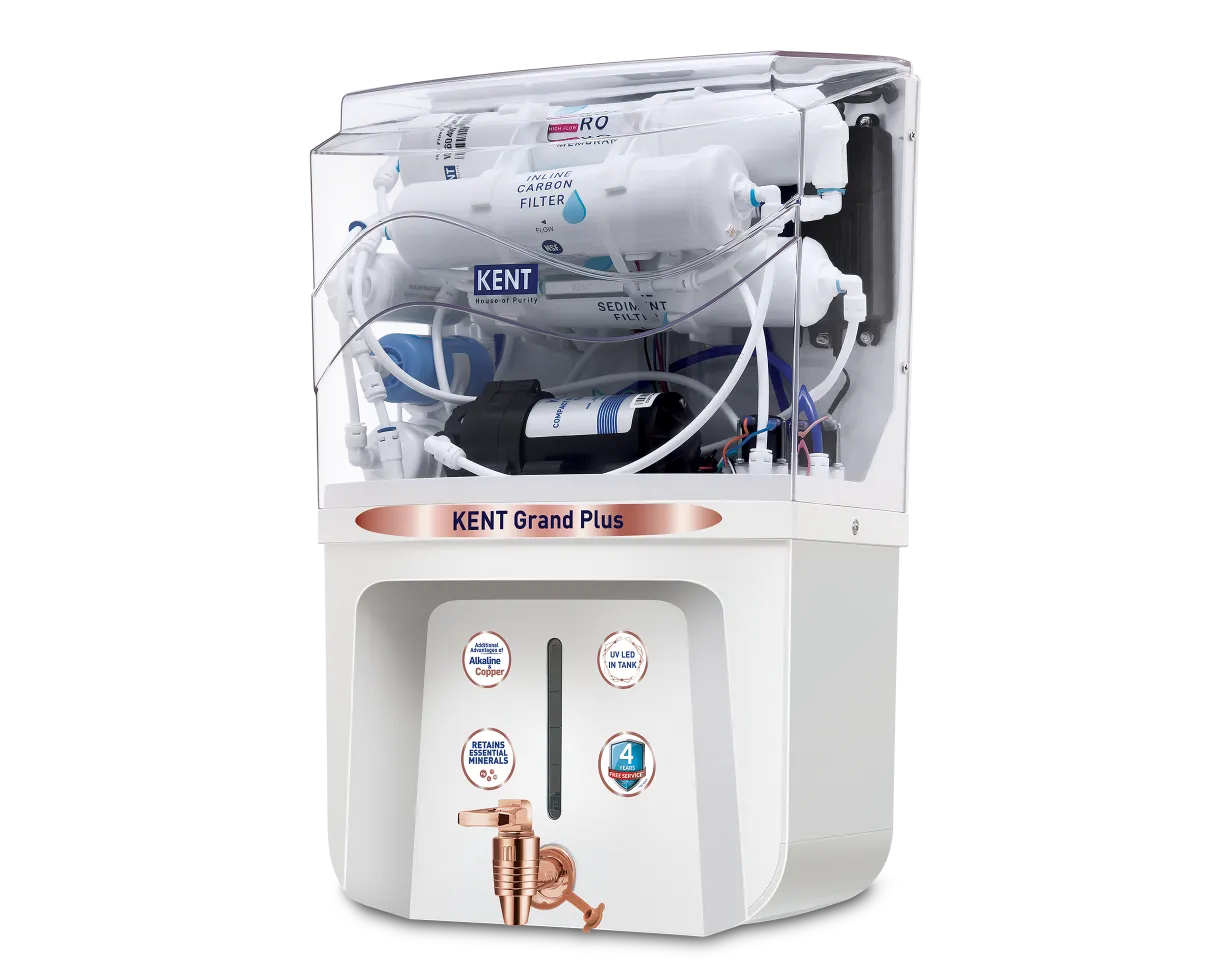
KENT Grand Plus

by KENT

8.9/10our editorial score
₹16,499M.R.P. ₹20,50020% off

Indicative price, verified 2026-08-01. Confirm on the marketplace before buying.

Running cost: ₹3,500/year in filters & servicing

  • RO + UV + UF + TDS Controller
  • 9 litres tank
  • Up to 2000 ppm TDS
  • TDS controller
  • High water recovery

If someone asks for one water purifier recommendation without telling me anything about their water, this is the answer. The Grand Plus is not the prettiest or the cheapest unit in this list, but it is the most consistently correct one: an RO membrane rated to 2,000 ppm input, UV and UF stages behind it, and a TDS controller so that low-TDS supply does not get stripped to tasteless.

LG PuriCare WW182EP water purifier by LG — product image
🏆 Best Tank Hygiene

LG PuriCare WW182EP

by LG

8.8/10our editorial score
₹31,990M.R.P. ₹39,00018% off

Indicative price, verified 2026-08-01. Confirm on the marketplace before buying.

Running cost: ₹4,400/year in filters & servicing

  • RO + Dual Protection Sterilising Care UV
  • 8 litres tank
  • Up to 2000 ppm TDS

Almost every purifier sold in India stores purified water in a sealed plastic tank at room temperature for hours at a time. In a Chennai or Kochi summer, that is an excellent environment for biofilm, and it is the failure mode nobody markets against. LG's answer is the right one on both counts: a stainless-steel tank that resists colonisation, and an automatic UV cycle that sterilises the tank and the outlet tap every couple of hours whether you remember to think about it or not.

Aquaguard Delight NXT water purifier by Aquaguard — product image
🏆 Best Service Network

Aquaguard Delight NXT

by Aquaguard

8.7/10our editorial score
₹17,990M.R.P. ₹23,50023% off

Indicative price, verified 2026-08-01. Confirm on the marketplace before buying.

Running cost: ₹4,200/year in filters & servicing

  • RO + UV e-boiling + UF + MTDS + Active Copper
  • 6 litres tank
  • Up to 2000 ppm TDS
  • Copper
  • TDS controller

The Delight NXT is what I recommend to people who have been burned by bad service. Purification-wise it is closely matched with the KENT Grand Plus — same 2,000 ppm ceiling, same core stages — so the decision comes down to two things: tank size and who shows up when it breaks. KENT gives you 9 litres; Aquaguard gives you 6 litres and Eureka Forbes' direct field force, which in my experience is the most dependable in Indian appliances.

AO Smith X7 water purifier by AO Smith — product image

AO Smith X7

by AO Smith

8.6/10our editorial score
₹23,490M.R.P. ₹30,00022% off

Indicative price, verified 2026-08-01. Confirm on the marketplace before buying.

Running cost: ₹4,000/year in filters & servicing

  • RO + SCMT + Mineraliser, 8-stage
  • 7 litres tank
  • Up to 2000 ppm TDS
  • TDS controller
  • High water recovery

The X7 is the smart-money AO Smith. You keep the build quality, the silver-charged membrane and — crucially — Advanced Recovery Technology, which is the brand's genuine engineering advantage. You give up hot water and drop from a 3,000 ppm to a 2,000 ppm input rating, which still covers the overwhelming majority of Indian supply.

Frequently asked questions

What is the difference between a water filter and a water purifier?
A filter physically strains water, excluding particles larger than its pore size and, with activated carbon, adsorbing some chemicals. A purifier additionally addresses microbes — through UV inactivation or an RO membrane — and RO also removes dissolved contaminants. Crucially, no filter reduces TDS. The terms are used loosely in marketing, so read the mechanism rather than the label.
Does a water filter remove TDS?
No. Sediment, carbon, ceramic and UF filters all pass dissolved salts straight through, so TDS is essentially unchanged. Only reverse osmosis reduces TDS at household scale, with the partial exception of ion-exchange jugs such as ZeroWater — which do work but become expensive per litre on high-TDS Indian water.
Is a candle water filter safe for drinking water?
Only for reasonably clear, low-TDS treated supply, and even then with caveats. A good ceramic candle excludes most bacteria and cysts but does not reliably remove viruses, and removes nothing dissolved — no arsenic, fluoride, nitrate or TDS. On borewell water, or anywhere with a known dissolved-contaminant issue, it provides false confidence rather than protection.
Does a Brita filter remove bacteria?
No. Brita's cartridges use activated carbon and ion exchange, which reduce chlorine taste, odour, limescale and some metals. They do not remove bacteria, viruses or dissolved salts. Treat a filter jug as a taste appliance for water that is already microbiologically safe — never as your sole protection.

Go deeper on this site

Related water quality topics

Free consultation · Pan-India

Not sure what you actually need? Ask us before you spend.

Tell us your city, your water source and your budget. For homes we will recommend the right technology — including telling you when a ₹3,000 purifier is genuinely enough. For offices, societies and factories, our team will size a system against your water report and send a specification-backed quotation.

Or email betterworkindia@gmail.com — attach a water analysis report and we can quote faster.

  • Homes

    Right-sized recommendation for your TDS, not the most expensive unit

  • Offices & societies

    25 LPH to 2,000+ LPH, sized on headcount and feed water

  • Industry

    Pharma, food, textile, boiler feed — engineered to your specification

  • Service & AMC

    Installation, repair and AMC with written response times

Pan-India installation & serviceAMC support availableFree site water-quality auditCustom-engineered to your TDSHow our quotation process works →