Skip to content

💧 Water technology · Head to head

Copper vs Alkaline Water Purifier: Two Add-Ons, Two Different Claims

6 min read · Updated

Copper RO

An RO purifier with a copper-dosing cartridge or copper-lined tank, adding a controlled trace of copper to the output.

Alkaline RO

An RO purifier with a mineral cartridge that adds calcium and magnesium back and raises pH to roughly 8-9.5.

Side by side

Copper RO compared with Alkaline RO
Copper ROAlkaline RO
What it addsTrace copperCalcium, magnesium; raises pH
Effect on TDSMarginal increaseIncrease of 40-80 ppm
Effect on pHLittleRaises to ~8.0-9.5
Effect on tasteSlight metallic note some people likeRounder, less flat
Traditional basisAyurvedic copper-vessel storageNone claimed
Strength of evidenceWeak for stated health benefitsSound for re-mineralisation; weak for health claims
Typical premium₹2,000-5,000₹5,000-8,000
Annual cartridge cost₹600-1,200₹800-1,500
Needs periodic cleaningYes — copper surfaces oxidiseNo
Copper RO compared with Alkaline RO

Choose Copper RO if…

  • You already store water in copper vessels and want the same thing without the daily cleaning.
  • You want a small taste change and a modest premium rather than a large one.
  • The unit publishes its copper dosing figure and it sits comfortably inside the BIS limit.

Choose Alkaline RO if…

  • Your input TDS is high, so RO output is genuinely stripped and re-mineralisation has something to do.
  • Flat-tasting RO water is your actual complaint.
  • You would rather pay for calcium and magnesium, which are dietary minerals, than for copper, which is needed only in traces.

Both sit in the same place in the machine

Neither of these is a purification stage. On the flow diagram, both appear after the RO membrane and usually after the UV lamp: the water has already been purified, and the cartridge is deciding what goes back into it before it reaches the tap.

That framing is useful when comparing prices. You are not comparing two purifiers — you are comparing two optional post-treatments on the same purifier, and you should judge them on what they add per rupee.

The copper question, fairly stated

Storing drinking water in copper vessels is a genuine and old Indian practice, and copper does have antimicrobial properties at the surface. The purifier version dissolves a controlled trace into water that has already been sterilised by UV and stripped by RO, so the antimicrobial argument has very little left to do.

Copper is also an essential trace nutrient, but the quantities involved are small relative to diet, and excessive copper is not benign. BIS IS 10500 sets 0.05 mg/L as the acceptable limit for drinking water. A well-designed unit doses well below anything problematic and should be able to tell you its figure; a unit whose brochure talks about copper's benefits without publishing a dosing number is selling atmosphere.

Note

If you buy copper, ask for the dosing figure in mg/L and ask how the copper element is cleaned. Copper surfaces oxidise, and an unmaintained copper cartridge is a maintenance item, not a permanent feature.

What we would actually buy

If your input TDS is above 600 ppm, the RO output is genuinely mineral-poor and an alkaline or mineraliser cartridge earns its place — you are replacing something that was removed, and you will taste the difference.

If your input TDS is 200-400 ppm, skip both and set the TDS controller to land around 80-100 ppm. You will get the taste benefit from water that was never stripped in the first place, at zero recurring cost.

Buy copper if you like the idea and the taste, and price it as a preference. It is not a health investment and no honest seller will present it as one.

Frequently asked questions

Is a copper water purifier better than an alkaline one?
They do different things. Copper adds a trace of copper for taste and tradition; alkaline adds calcium and magnesium and raises pH, which directly addresses the flat taste of RO water. On evidence and practical benefit, alkaline is the stronger of the two — though on low-TDS input neither is necessary.
Is copper RO water safe to drink daily?
Yes, provided the unit doses conservatively. BIS sets 0.05 mg/L as the acceptable copper limit for drinking water. Buy from a brand that publishes its dosing figure and keep the copper element serviced — an oxidised, unmaintained element is the failure mode worth avoiding.
Do copper purifiers reduce TDS?
The RO membrane in them does. The copper cartridge itself slightly increases TDS, because it is adding copper to the water rather than removing anything.
Can I get the benefits without paying the premium?
Largely, yes. For taste, set your RO's TDS controller to leave the output around 80-100 ppm instead of 30 ppm. For copper, a traditional copper vessel costs a few hundred rupees, though it needs cleaning every few days.

Still not sure which one your home needs?

Tell us your city and TDS reading and we will tell you which technology is actually required — including when the honest answer is the cheaper one.

Go deeper

Other comparisons like this

Our current top water purifiers

AO Smith Z9 Green RO water purifier by AO Smith — product image
🏆 Best Premium / Best Hot Water

AO Smith Z9 Green RO

AO Smith

9.0/10
₹33,99019% off
  • RO + SCMT
  • 9 litres tank
  • Up to 3000 ppm TDS

Premium kitchens, high-TDS or brackish supply, and households that drink a lot of tea and coffee.

View details
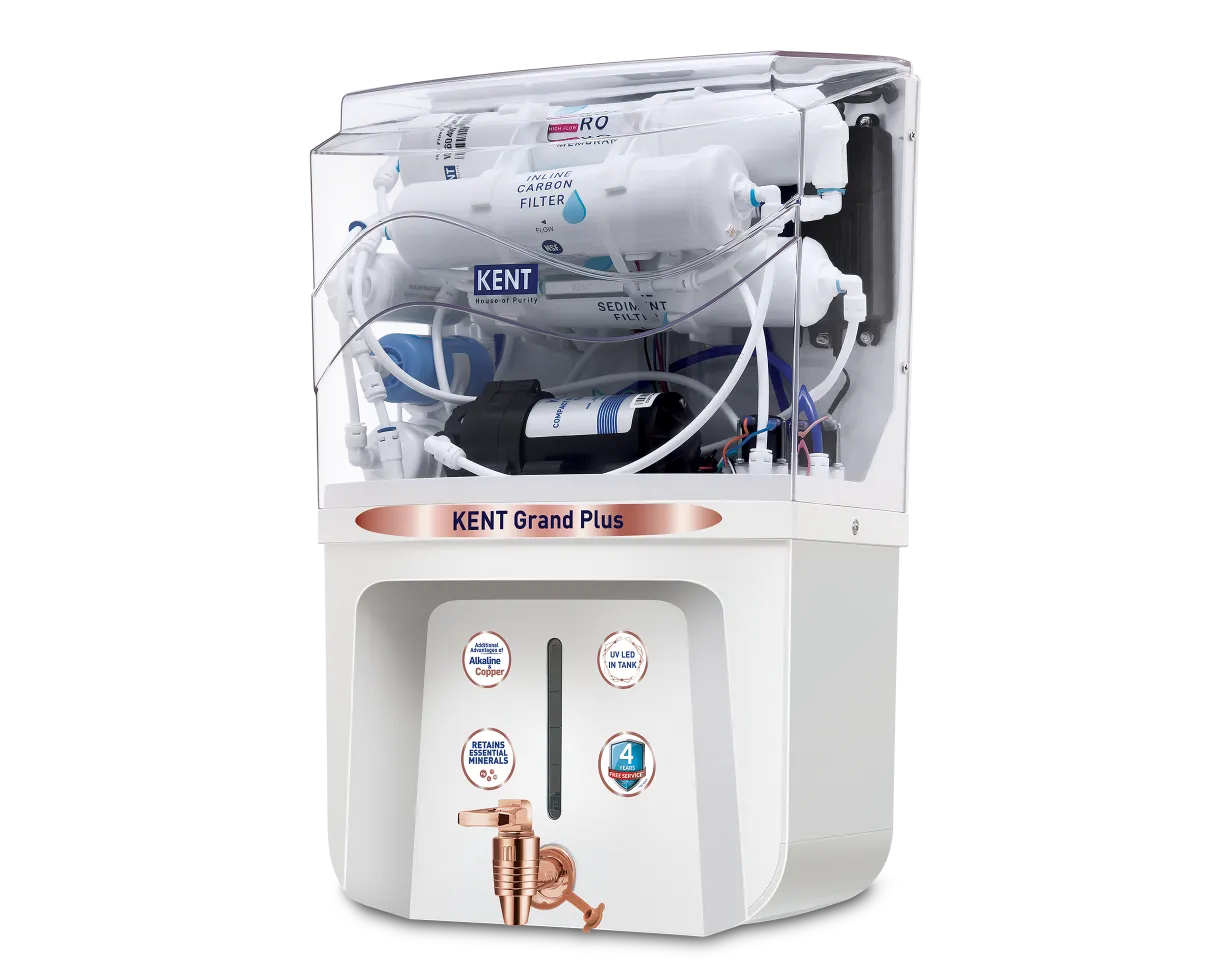
KENT Grand Plus water purifier by KENT — product image
🏆 Best Overall

KENT Grand Plus

KENT

8.9/10
₹16,49920% off
  • RO + UV + UF + TDS Controller
  • 9 litres tank
  • Up to 2000 ppm TDS

Families on borewell, tanker or high-TDS municipal supply who want the safest all-round choice.

View details
LG PuriCare WW182EP water purifier by LG — product image
🏆 Best Tank Hygiene

LG PuriCare WW182EP

LG

8.8/10
₹31,99018% off
  • RO + Dual Protection Sterilising Care UV
  • 8 litres tank
  • Up to 2000 ppm TDS

Hygiene-focused buyers, humid coastal cities, and anyone who has ever opened a purifier tank and been unpleasantly surprised.

View details
Aquaguard Delight NXT water purifier by Aquaguard — product image
🏆 Best Service Network

Aquaguard Delight NXT

Aquaguard

8.7/10
₹17,99023% off
  • RO + UV e-boiling + UF + MTDS + Active Copper
  • 6 litres tank
  • Up to 2000 ppm TDS

Buyers who value service reliability and compact design over maximum tank capacity.

View details

See the full ranking →

Free consultation · Pan-India

Not sure what you actually need? Ask us before you spend.

Tell us your city, your water source and your budget. For homes we will recommend the right technology — including telling you when a ₹3,000 purifier is genuinely enough. For offices, societies and factories, our team will size a system against your water report and send a specification-backed quotation.

Or email betterworkindia@gmail.com — attach a water analysis report and we can quote faster.

  • Homes

    Right-sized recommendation for your TDS, not the most expensive unit

  • Offices & societies

    25 LPH to 2,000+ LPH, sized on headcount and feed water

  • Industry

    Pharma, food, textile, boiler feed — engineered to your specification

  • Service & AMC

    Installation, repair and AMC with written response times

Pan-India installation & serviceAMC support availableFree site water-quality auditCustom-engineered to your TDSHow our quotation process works →