💧 Water purifier guide
How Much Water Does an RO Purifier Waste, and What Can You Do About It?
Why rejection is intrinsic, not a design flaw
An RO membrane separates water from dissolved salts. The salts have to leave in something, and that something is a continuous stream of concentrate. If you tried to recover every drop of purified water, the concentration at the membrane surface would rise until salts precipitated and scaled it solid within days.
So the reject stream is doing a job: it carries the rejected salts away and keeps the membrane surface swept clean. What varies between purifiers is the recovery ratio — how much of the feed becomes product — not whether there is a reject at all.
| Recovery | Reject per litre purified | Typical of |
|---|---|---|
| 25% | 3 litres | Older or poorly maintained units, low inlet pressure |
| 33% | 2 litres | The common Indian domestic case |
| 50% | 1 litre | Good modern units with an adequate booster pump |
| 60-75% | 0.3-0.7 litres | High-recovery designs, usually with a permeate pump |
| 'Zero waste' | 0 to drain | Reject pumped back to the overhead tank — not eliminated |
What it costs a household over a year
A family of four drinking and cooking gets through roughly 20 litres of purified water a day. At a 1:3 ratio that means 60 litres to drain daily — about 22,000 litres a year. At 1:1 it falls to about 7,300 litres.
In Bengaluru, Chennai, Pune or anywhere on tanker supply, that difference has a direct cost. It is also the strongest practical argument for not fitting RO where the water does not need it: on 150 ppm municipal supply, an RO purifier is discarding 22,000 litres a year to solve a problem the treatment plant already solved.
Five things that actually reduce it
- Fix your inlet pressure. This is the biggest single lever and the most overlooked. A membrane starved of pressure produces less permeate and more reject, so a working booster pump can move a unit from 1:3 to 1:2 with no other change.
- Service on schedule. A fouled or scaled membrane rejects more and produces less. The ratio degrading over time is one of the clearest signs a membrane is near the end of its life.
- Buy a high-recovery model if you are replacing a unit. Modern designs with permeate pumps reach 50-75% recovery, and the premium is modest.
- Collect the reject. A 20-litre canister under the purifier fills itself and covers most household cleaning. This is the highest-impact change most households can make today, for zero cost.
- Do not fit RO where you do not need it. On low-TDS treated supply, UV+UF wastes nothing at all and costs less to buy and run.
What the reject water is good for — and what it is not
Reject water is your tap water at roughly two to four times its original TDS. If your supply is 300 ppm, the reject is around 900 ppm — brackish, but nowhere near seawater and not contaminated in any new way. It contains nothing that was not already in your supply.
| Use | Suitable? | Note |
|---|---|---|
| Flushing toilets | Yes | The single best use. A cistern takes 6-10 L per flush |
| Mopping floors | Yes | May leave slight residue on dark tiles at very high TDS |
| Washing utensils (pre-rinse) | Yes | Rinse finally with normal water to avoid spotting |
| Car and two-wheeler washing | Yes, with care | Dry immediately; high-TDS water spots paint |
| Laundry | Sometimes | Only at moderate TDS; hardness reduces detergent performance |
| Watering plants | Cautiously | Fine at under ~600 ppm; salt accumulates in pots over time |
| Drinking or cooking | No | It is concentrate. That is the entire point |
| Aquariums | No | The TDS swing is dangerous to fish |
Important
The truth about 'zero waste' purifiers
These do not perform some new separation. They pump the reject stream back into your overhead storage tank instead of down the drain, so nothing leaves the building.
The catch is arithmetic. You are returning concentrated water to the tank that feeds the purifier, so the tank's TDS creeps up over the day and resets only when the tank refills from the mains. The effect is modest on a large tank with frequent refills and significant on a small tank filled once daily.
They are a reasonable choice where drainage is genuinely impossible or water is very expensive, provided your tank is large and refills often. They are not a free lunch, and a seller who describes them as one is worth being sceptical of.
Frequently asked questions
How much water does an RO purifier waste?
Can RO reject water be reused?
Are zero waste RO purifiers really zero waste?
Why is my RO purifier suddenly wasting more water?
How can I reduce RO water wastage?
Still not sure which water purifier fits?
Tell us your city and situation. We will give you a straight answer — including when the honest answer is that you do not need to spend much at all.
Shortlists that follow this advice
- Best Zero-Waste & High-Recovery RO Water Purifiers (2026)zero waste ro water purifier
- Best RO Water Purifiers in India (2026)best ro water purifier in india
- Best Water Purifiers Under ₹15,000 in India (2026)water purifier under 15000
- Best Countertop Water Purifiers in India (2026)countertop water purifier
Read next
Our current top water purifiers

AO Smith Z9 Green RO
AO Smith
- RO + SCMT
- 9 litres tank
- Up to 3000 ppm TDS
Premium kitchens, high-TDS or brackish supply, and households that drink a lot of tea and coffee.
View details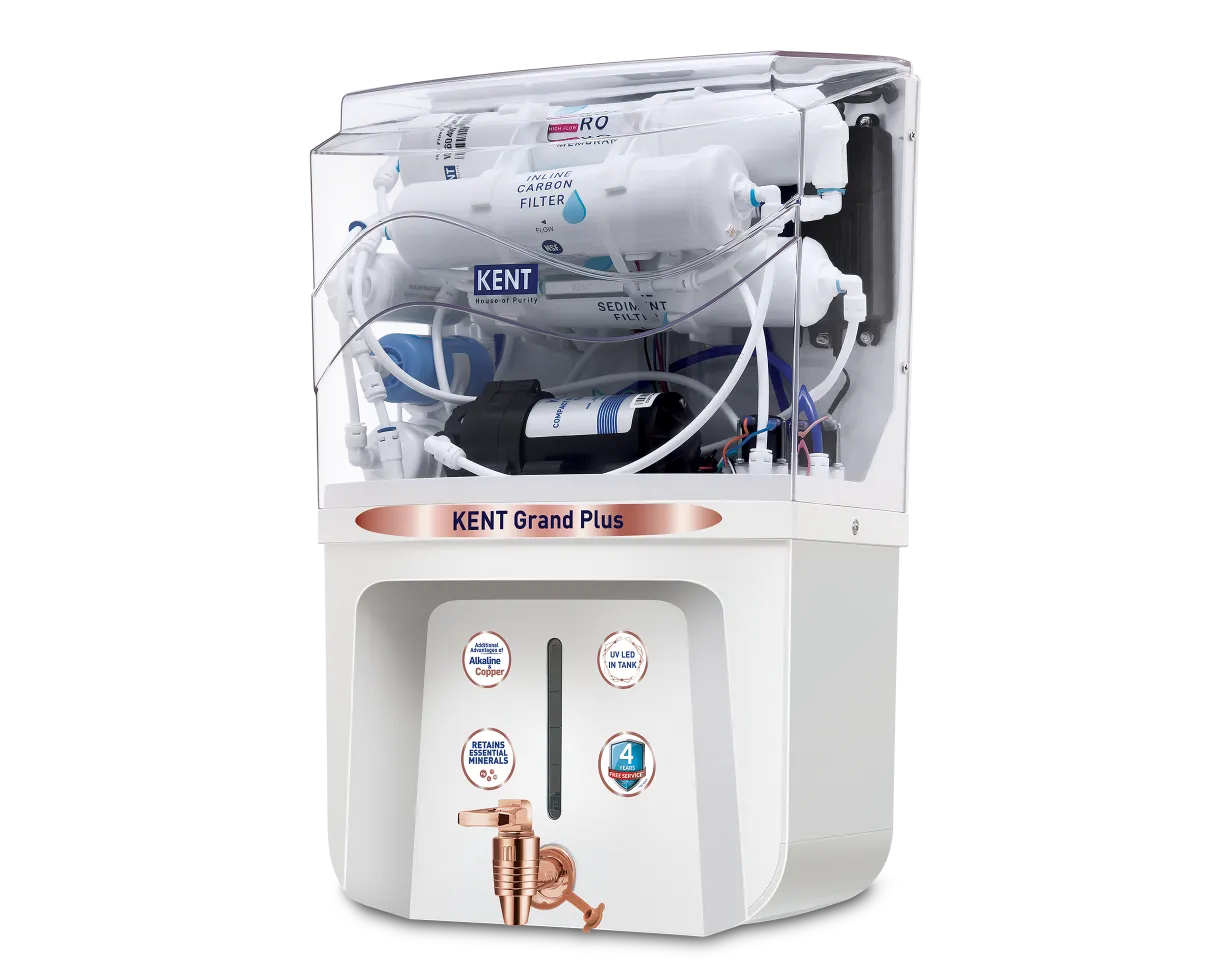
KENT Grand Plus
KENT
- RO + UV + UF + TDS Controller
- 9 litres tank
- Up to 2000 ppm TDS
Families on borewell, tanker or high-TDS municipal supply who want the safest all-round choice.
View details
LG PuriCare WW182EP
LG
- RO + Dual Protection Sterilising Care UV
- 8 litres tank
- Up to 2000 ppm TDS
Hygiene-focused buyers, humid coastal cities, and anyone who has ever opened a purifier tank and been unpleasantly surprised.
View details
Aquaguard Delight NXT
Aquaguard
- RO + UV e-boiling + UF + MTDS + Active Copper
- 6 litres tank
- Up to 2000 ppm TDS
Buyers who value service reliability and compact design over maximum tank capacity.
View details