💧 Water purifier guide
What an RO Purifier Removes — and the Things It Does Not
The complete answer table
| Contaminant | Removed by RO? | Typical rejection | Notes |
|---|---|---|---|
| Total dissolved solids | Yes | 90-98% | The defining capability. Nothing else domestic does this |
| Hardness (Ca, Mg) | Yes | 95-98% | Removes scale-formers, and the useful minerals with them |
| Sodium / salinity | Yes | 90-98% | Why RO works on coastal and brackish supply |
| Arsenic (As-V) | Yes | 95-99% | As-III is removed less well; pre-oxidation improves it |
| Fluoride | Yes | 85-95% | The main domestic option for the fluoride belt |
| Nitrate | Yes | 85-95% | Critical where farming has contaminated groundwater |
| Lead | Yes | 95-99% | Usually a plumbing problem rather than a supply one |
| Iron (dissolved) | Partly | Variable | High iron should be pre-treated; it fouls membranes |
| Bacteria | Yes | >99.99% | Physically excluded, not killed |
| Viruses | Yes | >99.9% | Still far larger than the membrane's pores |
| Cysts (Giardia, Crypto) | Yes | >99.99% | Orders of magnitude too large to pass |
| Pesticide residues | Mostly | 85-95% | Larger molecules are removed well; carbon helps too |
| Chlorine | No | — | Removed by the pre-carbon block, which protects the membrane |
| Dissolved gases (CO₂, H₂S) | No | — | Pass through; H₂S needs separate treatment |
| Some low-MW VOCs | Partly | Variable | Carbon stages do most of this work |
Why it removes microbes without being a disinfection device
An RO membrane's effective pore size is around 0.0001 microns. The smallest viruses are roughly 0.02 microns — two hundred times larger. Bacteria are thousands of times larger. Exclusion is therefore near-total, and it is physical rather than chemical, so nothing has to be dosed and nothing survives in an inactive form.
The reason RO purifiers still carry a UV lamp is not that the membrane is inadequate. It is that a membrane can fail — a pinhole, a compromised seal, a badly seated cartridge — and that contamination can enter the system downstream of the membrane, in the storage tank or tubing. UV is the backstop for both.
The contaminants where the detail matters
- Arsenic — RO removes arsenate (As-V) at 95-99%, but arsenite (As-III), the form more common in reducing groundwater, is removed less reliably. Where arsenic is a known problem, use a purifier with a pre-oxidation stage and confirm removal with a lab test on the output, not just on the input.
- Fluoride — rejection is typically 85-95%, which brings most Indian fluoride-belt water inside the 1.0 mg/L limit but may not be enough at very high source concentrations. Test the output if your area is severely affected.
- Iron — dissolved iron passes partly and, worse, oxidises and fouls the membrane. Water with visible iron staining should be pre-treated with an iron removal filter ahead of the RO, not simply pushed through it.
- Hydrogen sulphide — the rotten-egg smell is a dissolved gas that passes straight through. It needs aeration or oxidising media, not RO.
- Chlorine — not only unremoved by the membrane but actively destructive to it. The pre-carbon block exists to strip chlorine before it reaches the membrane, which is why skipping that cartridge is the most expensive economy in the whole machine.
What it removes that you would rather keep
RO is indiscriminate. Calcium and magnesium go out with the arsenic, and so do the bicarbonates that buffer pH. Output at 20-30 ppm is mineral-poor, mildly acidic and tastes flat.
The remedy is not exotic. A TDS controller blends a measured amount of pre-membrane water back in, landing the output at 60-100 ppm — enough to taste like water and to retain some mineral content. Mineraliser and alkaline cartridges achieve something similar by dosing minerals in after the membrane.
Worth keeping in proportion: drinking water is a minor contributor to dietary calcium and magnesium compared with food. The taste argument for a TDS controller is stronger than the nutritional one, and both point the same way.
How to know your membrane is still doing its job
A failing RO membrane looks exactly like a working one. There is no noise, no leak and no indicator. The only reliable signal is the output TDS.
Measure the output the week the purifier is installed and write the number down. Measure again every three months. A reading that has climbed substantially — say from 45 ppm to 140 ppm on unchanged input — means the membrane is passing what it used to reject, and it is time to replace it regardless of what the service schedule says.
Tip
Frequently asked questions
Does RO remove bacteria and viruses?
Does RO remove arsenic and fluoride?
Does an RO purifier remove hardness?
Does RO remove chlorine?
Does RO remove essential minerals from water?
Still not sure which water purifier fits?
Tell us your city and situation. We will give you a straight answer — including when the honest answer is that you do not need to spend much at all.
Shortlists that follow this advice
- Best Water Purifiers for Heavy Metals, Arsenic & Fluoride (2026)heavy metal water filter
- Best RO Water Purifiers in India (2026)best ro water purifier in india
- Best Water Purifiers for High TDS Water (2026)best water purifier for high tds
- Best Stainless Steel Tank Water Purifiers in India (2026)stainless steel tank water purifier
Read next
Our current top water purifiers

AO Smith Z9 Green RO
AO Smith
- RO + SCMT
- 9 litres tank
- Up to 3000 ppm TDS
Premium kitchens, high-TDS or brackish supply, and households that drink a lot of tea and coffee.
View details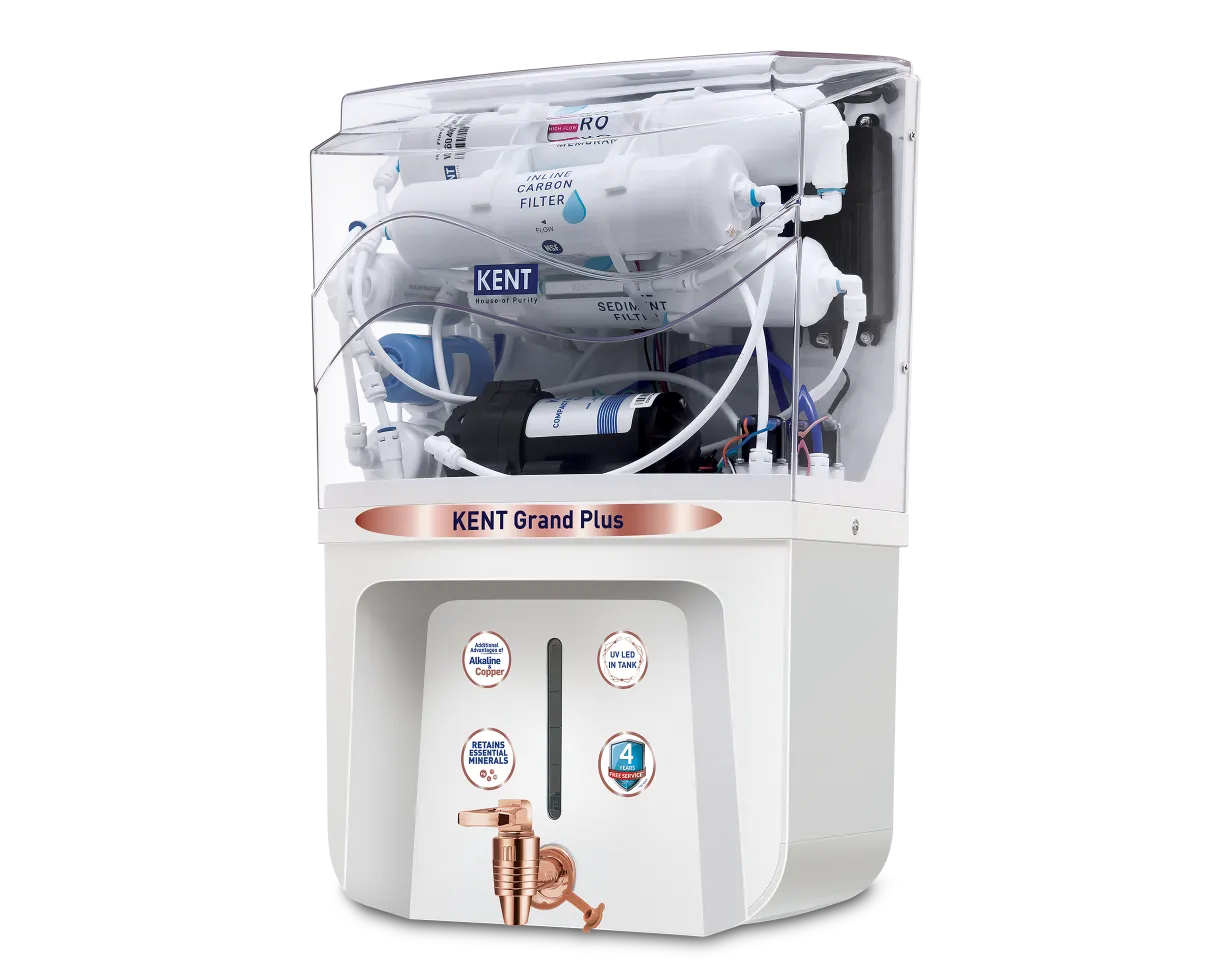
KENT Grand Plus
KENT
- RO + UV + UF + TDS Controller
- 9 litres tank
- Up to 2000 ppm TDS
Families on borewell, tanker or high-TDS municipal supply who want the safest all-round choice.
View details
LG PuriCare WW182EP
LG
- RO + Dual Protection Sterilising Care UV
- 8 litres tank
- Up to 2000 ppm TDS
Hygiene-focused buyers, humid coastal cities, and anyone who has ever opened a purifier tank and been unpleasantly surprised.
View details
Aquaguard Delight NXT
Aquaguard
- RO + UV e-boiling + UF + MTDS + Active Copper
- 6 litres tank
- Up to 2000 ppm TDS
Buyers who value service reliability and compact design over maximum tank capacity.
View details