💧 Water purifier guide
What Do UV and UF Water Purification Actually Do?
UV: killing without removing
A UV purifier passes water through a quartz sleeve alongside a low-pressure mercury lamp emitting at 254 nm. That wavelength is absorbed strongly by nucleic acids, and the damage it causes prevents bacteria, viruses and cysts from replicating. It is fast, chemical-free and leaves no taste.
What it does not do is remove anything. The inactivated organisms are still in the glass you drink, along with every dissolved salt and every particle that entered. For treated municipal supply that is entirely adequate — an inactivated bacterium cannot colonise you — but it is not what most people picture when told water has been purified.
Important
The silent-failure problem, and the one habit that fixes it
A UV lamp's germicidal output decays steadily and is typically down to an inadequate level after roughly 8,000-9,000 hours — about a year of continuous running — while still emitting visible light. The purifier looks as though it is working. Nothing about its behaviour tells you otherwise.
Better units fit a UV sensor or a lamp-hours alarm that cuts the outlet when the lamp is due. Cheaper ones do not. Either way, the single most valuable habit with a UV purifier is replacing the lamp annually on a calendar. A UV purifier with a two-year-old lamp is a storage tank with a light in it.
UF: removing without power
Ultrafiltration uses a bundle of hollow fibres with pores around 0.01-0.1 microns. Water passes through the fibre walls; anything larger stays on the outside. That covers bacteria at 0.2-2 microns, Giardia and Cryptosporidium cysts at 4-15 microns, silt, rust and colloidal matter comfortably.
The two properties that make UF genuinely valuable in India are that it needs no electricity — ordinary tap or gravity pressure is enough — and that it wastes no water. That makes it the correct technology for gravity-based purifiers, for homes with frequent power cuts, and for anyone who objects to discarding two litres to drink one.
| UV | UF | |
|---|---|---|
| Bacteria | Inactivated | Removed |
| Viruses | Inactivated — its strongest suit | Partially; many are smaller than the pores |
| Cysts | Effective at correct dose | Removed outright |
| Sediment / turbidity | Not removed, and it blocks the lamp | Removed |
| Dissolved solids | No | No |
| Electricity | Required | Not required |
| Consumable | Lamp, ~₹800/year | Cartridge, ₹600-1,200 every 6-12 months |
| Failure visible? | No | Yes — flow rate drops |
Why UV+UF is the right purifier for low-TDS water
The two technologies cover each other's weaknesses almost exactly. UF removes the sediment that would otherwise shadow the UV lamp, and removes bacteria and cysts outright. UV handles the viruses small enough to slip through UF's pores. Neither wastes water and neither strips minerals.
For a household on treated municipal supply measuring under about 200 ppm, a well-built UV+UF purifier at ₹7,000-12,000 is the technically correct purchase. The ₹18,000 RO unit a salesperson would rather sell is solving a problem that supply does not have, at roughly ₹17,000 more over five years.
What neither of them can do
- Reduce TDS. Not by one ppm. If your meter reads 800, it will still read 800 after both stages.
- Remove hardness. Scale on your utensils and geyser is calcium and magnesium, and both technologies leave them untouched.
- Remove arsenic, fluoride, nitrate or lead. These are the contaminants that are invisible, tasteless and genuinely dangerous, and they need RO.
- Improve the taste of salty or bitter water. That taste is dissolved content, so nothing here will change it.
- Handle borewell, tanker or coastal supply adequately. Those need RO, with UV behind it.
Frequently asked questions
What is UV water purification?
What is UF in a water purifier?
Do UV and UF purifiers reduce TDS?
How often should a UV lamp be replaced?
Is a UV+UF purifier enough for municipal water?
Still not sure which water purifier fits?
Tell us your city and situation. We will give you a straight answer — including when the honest answer is that you do not need to spend much at all.
Shortlists that follow this advice
Read next
Our current top water purifiers

AO Smith Z9 Green RO
AO Smith
- RO + SCMT
- 9 litres tank
- Up to 3000 ppm TDS
Premium kitchens, high-TDS or brackish supply, and households that drink a lot of tea and coffee.
View details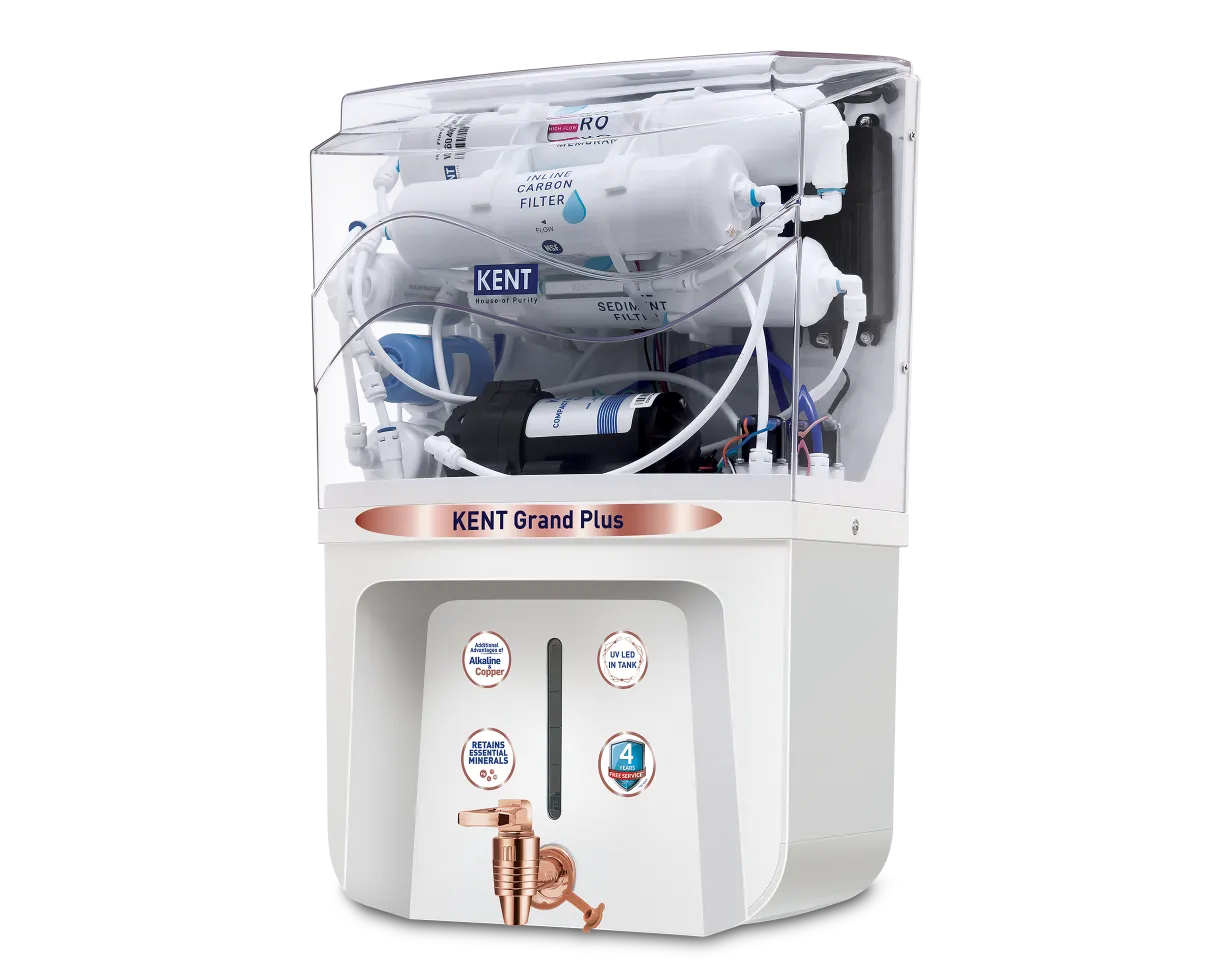
KENT Grand Plus
KENT
- RO + UV + UF + TDS Controller
- 9 litres tank
- Up to 2000 ppm TDS
Families on borewell, tanker or high-TDS municipal supply who want the safest all-round choice.
View details
LG PuriCare WW182EP
LG
- RO + Dual Protection Sterilising Care UV
- 8 litres tank
- Up to 2000 ppm TDS
Hygiene-focused buyers, humid coastal cities, and anyone who has ever opened a purifier tank and been unpleasantly surprised.
View details
Aquaguard Delight NXT
Aquaguard
- RO + UV e-boiling + UF + MTDS + Active Copper
- 6 litres tank
- Up to 2000 ppm TDS
Buyers who value service reliability and compact design over maximum tank capacity.
View details