Skip to content

💧 Water technology · Head to head

RO+UV vs RO+UV+UF: Does the Extra Stage Buy You Anything?

6 min read · Updated

RO + UV

Membrane separation plus a UV lamp. Covers dissolved contaminants and microbiological risk.

RO + UV + UF

The same, plus a hollow-fibre membrane as a final physical barrier between the tank and your glass.

Side by side

RO + UV compared with RO + UV + UF
RO + UVRO + UV + UF
Removes dissolved solidsYesYes
Kills bacteria and virusesYesYes
Physically removes post-RO contaminationNoYes
Protects against a membrane pinholePartly — UV still inactivatesYes — physical exclusion as well
Protects against tank biofilmOnly if the UV sits after the tankYes
Extra purchase cost₹1,000-2,500
Extra annual consumables₹500-900
Flow rate impactNoneSlight drop as the cartridge loads
Worth it on a tankless unitRarely
RO + UV compared with RO + UV + UF

Choose RO + UV if…

  • Your purifier is a tankless, direct-flow model — there is no standing water for UF to protect.
  • You are on a tight budget and would rather spend the difference on a higher-rated membrane.
  • Your supply is continuous and your service network is dependable.

Choose RO + UV + UF if…

  • Your purifier has a 7-10 litre storage tank sitting at Indian room temperature.
  • Your supply is intermittent, so the tank stands part-full for long periods.
  • Service in your city is unreliable and intervals slip past the recommended schedule.
  • Anyone in the household is immunocompromised, elderly or an infant.

What UF is actually doing in this position

Behind an RO membrane, UF is not purifying the incoming water — the membrane already did that far more comprehensively than UF ever could. It is guarding the space between the membrane and the tap.

That space matters more than people expect. A storage tank holding treated, chlorine-free water at 28-32 °C is an excellent environment for biofilm. Add an intermittent municipal supply, so the tank sits half-full for days, and a service interval that has slipped from 6 months to 11, and the last stage before your glass becomes the one doing real work.

Where the UV lamp sits changes the answer

Read the flow diagram on the box, not the stage count. In some designs UV sits before the tank, which means everything after it — tank, tubing, tap — is unprotected. In better designs the UV lamp is in-line at the outlet, treating water on its way out.

If the UV is pre-tank, a UF stage after the tank is genuinely valuable. If UV is post-tank, the UF is a redundant belt on top of working braces, and worth having only if the incremental cost is small.

Tip

Ask one question at the showroom: 'Is the UV lamp before or after the storage tank?' The answer tells you more about the purifier than any stage count on the carton.

The stage-count trap

Indian purifier marketing has inflated stage counts to the point of meaninglessness. A sediment pad, a pre-carbon block, a post-carbon polisher and a 'mineral cartridge' get counted as four stages, so a machine with one RO membrane and one UV lamp is advertised as 8-stage, 10-stage or 12-stage.

Ignore the number. Confirm four things are physically present: an RO membrane with a stated TDS rating, a UV lamp with a stated wattage, a UF membrane if you are paying for one, and a working TDS controller. A well-made 6-stage purifier from a brand that services your pin code will outperform a 12-stage unit from one that does not.

Frequently asked questions

Is RO+UV+UF better than RO+UV?
Marginally, and specifically in one way: the UF membrane physically blocks anything that enters the system after the RO stage, which mostly means storage-tank contamination. On a tank purifier with a pre-tank UV lamp it is worth the ₹1,500. On a tankless direct-flow purifier it adds very little.
Do I need UF if I already have RO?
You do not need it for purification — RO already removes everything UF would. You may want it as a safety barrier on the outlet side, particularly if your purifier stores water and your service intervals are irregular.
Does more stages mean better purification?
No. Stage counts in India are a marketing number that includes cosmetic cartridges. What matters is which technologies are genuinely present — RO membrane, UV lamp, UF membrane, TDS controller — and how well the unit is built and serviced.
How much does the UF stage cost to maintain?
Roughly ₹500-900 a year, as the UF cartridge is typically replaced every 6-12 months alongside the other pre-filters. It is usually bundled into an AMC rather than billed separately.

Still not sure which one your home needs?

Tell us your city and TDS reading and we will tell you which technology is actually required — including when the honest answer is the cheaper one.

Go deeper

Other comparisons like this

Our current top water purifiers

AO Smith Z9 Green RO water purifier by AO Smith — product image
🏆 Best Premium / Best Hot Water

AO Smith Z9 Green RO

AO Smith

9.0/10
₹33,99019% off
  • RO + SCMT
  • 9 litres tank
  • Up to 3000 ppm TDS

Premium kitchens, high-TDS or brackish supply, and households that drink a lot of tea and coffee.

View details
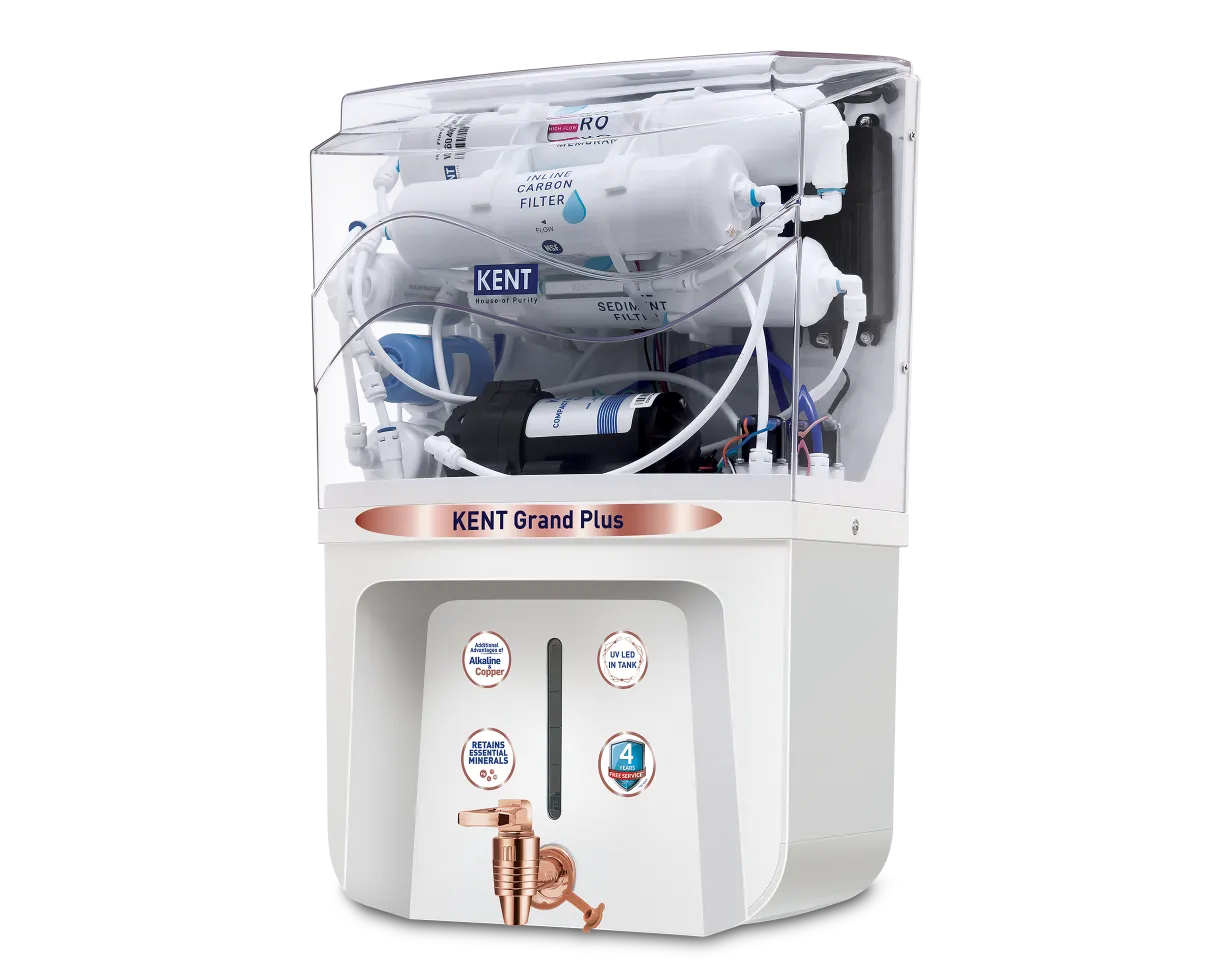
KENT Grand Plus water purifier by KENT — product image
🏆 Best Overall

KENT Grand Plus

KENT

8.9/10
₹16,49920% off
  • RO + UV + UF + TDS Controller
  • 9 litres tank
  • Up to 2000 ppm TDS

Families on borewell, tanker or high-TDS municipal supply who want the safest all-round choice.

View details
LG PuriCare WW182EP water purifier by LG — product image
🏆 Best Tank Hygiene

LG PuriCare WW182EP

LG

8.8/10
₹31,99018% off
  • RO + Dual Protection Sterilising Care UV
  • 8 litres tank
  • Up to 2000 ppm TDS

Hygiene-focused buyers, humid coastal cities, and anyone who has ever opened a purifier tank and been unpleasantly surprised.

View details
Aquaguard Delight NXT water purifier by Aquaguard — product image
🏆 Best Service Network

Aquaguard Delight NXT

Aquaguard

8.7/10
₹17,99023% off
  • RO + UV e-boiling + UF + MTDS + Active Copper
  • 6 litres tank
  • Up to 2000 ppm TDS

Buyers who value service reliability and compact design over maximum tank capacity.

View details

See the full ranking →

Free consultation · Pan-India

Not sure what you actually need? Ask us before you spend.

Tell us your city, your water source and your budget. For homes we will recommend the right technology — including telling you when a ₹3,000 purifier is genuinely enough. For offices, societies and factories, our team will size a system against your water report and send a specification-backed quotation.

Or email betterworkindia@gmail.com — attach a water analysis report and we can quote faster.

  • Homes

    Right-sized recommendation for your TDS, not the most expensive unit

  • Offices & societies

    25 LPH to 2,000+ LPH, sized on headcount and feed water

  • Industry

    Pharma, food, textile, boiler feed — engineered to your specification

  • Service & AMC

    Installation, repair and AMC with written response times

Pan-India installation & serviceAMC support availableFree site water-quality auditCustom-engineered to your TDSHow our quotation process works →