💧 Water purifier guide
What Is Hard Water, and What Actually Fixes It?
What hardness actually is
Rain is soft. It becomes hard underground, dissolving calcium and magnesium as it moves through limestone, chalk, dolomite and gypsum. That is why hardness in India tracks geology closely: much of Rajasthan, Gujarat, Haryana, Punjab, Telangana and inland Maharashtra sit on hardness-producing strata, while surface-water-supplied cities like Mumbai, Kolkata and much of Kerala are comparatively soft.
Hardness is measured in mg/L as calcium carbonate equivalent, or in ppm. It also shows up as a large fraction of your TDS reading — which is why hard-water areas usually read high on a TDS meter, and why the two get conflated at the point of sale.
| Hardness (mg/L as CaCO₃) | Classification | What you notice |
|---|---|---|
| 0-60 | Soft | Soap lathers freely, no scale |
| 60-120 | Moderately hard | Mild scale in the kettle over months |
| 120-180 | Hard | Visible scale, soap scum, dull laundry |
| 180-300 | Very hard | Rapid geyser scaling, dry skin and hair, appliance failures |
| Above 300 | Extremely hard | Whole-house treatment is not optional if you want appliances to last |
What it costs you
- Geysers and heating elements scale up, losing efficiency and eventually failing. A scaled element uses noticeably more electricity for the same hot water.
- Washing machines and dishwashers accumulate scale on heaters and drums, shortening life and requiring more detergent for the same result.
- Taps, showerheads and mixers block progressively. The white crust on a shower rose is the visible fraction of what is happening inside the pipe.
- Laundry goes grey and stiff. Hardness minerals react with detergent to form insoluble scum that deposits in fabric.
- Skin and hair suffer — soap scum is not rinsed away cleanly, which is behind a great deal of dryness and itchiness attributed to other causes.
- Tiles, glass and steel show permanent water spotting where hard water dries on the surface.
Why RO is the wrong tool for this
An RO purifier does remove hardness — 95-98% of it — but only from the water that goes through it, which is one tap producing 15-20 litres a day. Your geyser, washing machine, bathroom and kitchen sink continue to receive the full hardness of the supply.
This is a genuinely common and expensive misunderstanding. Households buy a ₹20,000 RO purifier expecting the scale problem to go away, and are then puzzled when the geyser fails two years later. Drinking-water treatment and whole-house treatment are different jobs requiring different equipment at different points in the plumbing.
Important
How a softener works, and what it costs
An ion-exchange softener passes water through a resin bed that swaps calcium and magnesium ions for sodium ions. The resin eventually fills up with hardness and is regenerated by flushing it with brine, which strips the calcium off and reloads the resin with sodium. That regeneration cycle is why a softener needs a salt tank and a drain.
In a domestic installation the softener sits at the inlet, treating everything except — ideally — one unsoftened tap kept for drinking and cooking.
| Item | Indicative cost | Note |
|---|---|---|
| Domestic softener, installed | ₹18,000-45,000 | Sized to household flow and hardness |
| Salt | ₹200-500/month | Depends on hardness and water use |
| Resin replacement | ₹4,000-9,000 every 5-8 years | Earlier on very hard or iron-bearing supply |
| Annual service | ₹1,500-3,000 | Valve, brine tank and settings check |
| Water used regenerating | 40-80 L per cycle | Typically every 3-7 days |
The alternatives, assessed honestly
- Anti-scale / template-assisted crystallisation (TAC) media — does not remove hardness but converts it to a form less prone to sticking. No salt, no drain, no wastewater. Evidence is mixed and it does nothing for soap scum or laundry, but it is a reasonable low-maintenance option at moderate hardness.
- Magnetic and electronic descalers — sold widely and cheaply. Independent evidence for these is weak to absent. We would not spend money here.
- Point-of-use shower filters — help with skin and hair complaints at low cost, and do nothing for the geyser or washing machine. Useful as a partial measure in a rented flat.
- Doing nothing plus periodic descaling — genuinely defensible at 120-180 mg/L if appliances are few. Above 250 mg/L the arithmetic stops working, because you are replacing appliances faster than a softener would have cost.
Should you drink softened water?
Not as a routine. Ion exchange replaces calcium and magnesium with sodium, roughly in proportion to the hardness removed. Softening very hard water can add a meaningful amount of sodium — which matters for anyone with hypertension, kidney disease or on a medically restricted sodium intake.
The standard arrangement is to keep one unsoftened tap in the kitchen for drinking and cooking, and to run your RO or UV purifier from that. This gives you soft water for everything that scales and unsoftened, purified water for everything you swallow.
Frequently asked questions
What causes hard water?
Is hard water bad for health?
Does an RO purifier remove hardness?
How much does a water softener cost in India?
Can you drink softened water?
Still not sure which water purifier fits?
Tell us your city and situation. We will give you a straight answer — including when the honest answer is that you do not need to spend much at all.
Shortlists that follow this advice
- Best Water Purifiers for Hard Water (2026)water purifier for hard water
- Best Water Purifiers for Borewell Water (2026)best water purifier for borewell water
- Whole House Water Filtration Systems in India (2026)whole house water filtration system
- Best Under-Sink Water Purifiers in India (2026)under sink water purifier
Read next
Our current top water purifiers

AO Smith Z9 Green RO
AO Smith
- RO + SCMT
- 9 litres tank
- Up to 3000 ppm TDS
Premium kitchens, high-TDS or brackish supply, and households that drink a lot of tea and coffee.
View details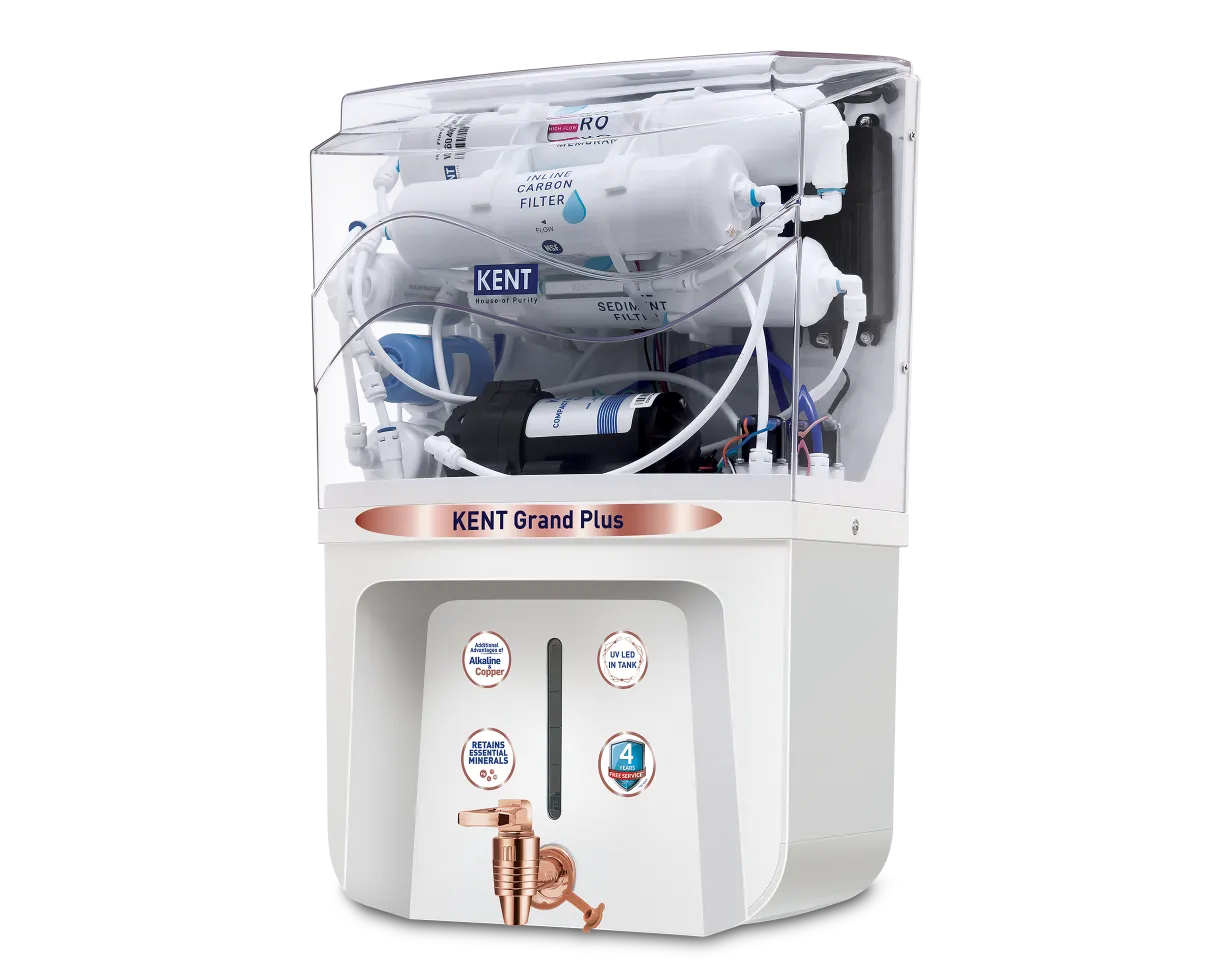
KENT Grand Plus
KENT
- RO + UV + UF + TDS Controller
- 9 litres tank
- Up to 2000 ppm TDS
Families on borewell, tanker or high-TDS municipal supply who want the safest all-round choice.
View details
LG PuriCare WW182EP
LG
- RO + Dual Protection Sterilising Care UV
- 8 litres tank
- Up to 2000 ppm TDS
Hygiene-focused buyers, humid coastal cities, and anyone who has ever opened a purifier tank and been unpleasantly surprised.
View details
Aquaguard Delight NXT
Aquaguard
- RO + UV e-boiling + UF + MTDS + Active Copper
- 6 litres tank
- Up to 2000 ppm TDS
Buyers who value service reliability and compact design over maximum tank capacity.
View details