💧 Water purifier guide
Which Water Purifier Do You Need for Your TDS Reading?
First, what the number does and does not tell you
TDS — total dissolved solids — is a measure of everything dissolved in the water, in parts per million. It is dominated by ordinary salts: calcium, magnesium, sodium, bicarbonates and chlorides. A ₹300 pen meter reads it in five seconds, which is why it has become the number every Indian purifier decision turns on.
It is a good proxy for one thing: whether you need a reverse-osmosis membrane at all. RO is the only domestic technology that lowers TDS, so a low reading means you can skip it and a high reading means you cannot. What TDS does not tell you is whether the water carries arsenic, fluoride, nitrate or bacteria — those can be present at any TDS, and a reading of 150 ppm from a contaminated borewell is more dangerous than 900 ppm of harmless salts. Treat the meter as the first test, not the only one.
Note
Under 200 ppm — buy UV+UF, not RO
Mumbai's lake supply, most of Kolkata, Kochi, Guwahati and the hill states sit here. The water is already soft and low in salts; what it may carry is bacteria and turbidity from old pipes and monsoon ingress. A UV lamp handles the microbes, a UF membrane catches cysts and sediment, and neither removes a single milligram of the minerals you would rather keep.
An RO on this water is actively worse. It will pull the TDS down to 20-40 ppm, the water will taste flat, and it will send two litres down the drain for every litre you drink. If a salesman tells you RO is 'more complete', ask him what it is completing.
- Buy: UV+UF wall-mount, ₹6,000-12,000. Gravity UF is fine if power is unreliable and the supply is municipally treated.
- Skip: anything with an RO membrane, unless a lab test shows arsenic, fluoride or nitrate.
200-350 ppm — the 'either' band; the source decides
A reading of 250 or 350 ppm is the most common question we get, because it sits on the fence. The BIS acceptable limit is 500, so the water is fine to drink as far as salts go, and UV+UF will make it safe. The reason people still buy RO here is that a fence-sitting reading from a borewell or tanker will not stay put — summer draws groundwater down and TDS climbs.
So the rule is about the source, not the number. Treated municipal supply at 350 ppm: UV+UF, and enjoy the minerals. Borewell, tanker, mixed or unknown supply at 350 ppm: RO+UV, and insist on a TDS controller so the output is blended back to 80-150 ppm rather than stripped to 30.
- Municipal at 200-350 ppm: UV+UF, ₹6,000-12,000.
- Borewell or tanker at 200-350 ppm: RO+UV with TDS controller or mineraliser, ₹8,000-15,000.
350-600 ppm — RO+UV, with a TDS controller
This is the band Indian RO purifiers are built for. Delhi's central zones, Pune, Hyderabad's core, Chennai's Krishna-water areas and most of the NCR sit here. The water is drinkable on salts alone but noticeably hard, scales kettles and tastes heavy, and above 500 ppm it is outside the BIS acceptable limit.
A standard 75-80 GPD domestic membrane takes 600 ppm down to 30-60 ppm without effort. The feature that matters is what happens next: a TDS controller or mineraliser blends or re-adds minerals so you drink 80-150 ppm rather than near-distilled water. Without it, RO water in this band tastes flat and you will be tempted to stop using the machine.
- Buy: RO+UV with TDS controller, ₹8,000-16,000. Copper or alkaline post-stages are a taste preference, not a safety feature.
- Wastage: expect about 2 litres rejected per litre purified. Collect it for mopping and plants.
- Membrane life: 18-24 months at this TDS with a working sediment pre-filter.
600-1,000 ppm — RO+UV, and the membrane rating matters
Readings of 750, 850 or 900 ppm are routine in Gurugram, Noida, Faridabad, Jaipur, outer Bengaluru and any borewell-fed apartment. Above the 500 ppm BIS acceptable limit, RO stops being optional. What changes at this level is that the cheapest membranes begin to struggle: rejection drops, output slows, and the membrane is done in a year.
Look for a membrane rated for a feed TDS of 2,000 ppm — KENT, Aquaguard, AO Smith, Havells and Pureit all specify this on their better models, and the number is on the spec sheet. Pair it with a sediment pre-filter you change every six months, because scale and silt are what actually kill membranes at this TDS.
- Buy: RO+UV with a 2,000 ppm-rated membrane and TDS controller, ₹10,000-18,000.
- Wastage: 2.5-3 litres per litre purified. A zero-waste or low-waste model recovers some of it into the overhead tank.
- Membrane life: 12-18 months. Budget ₹2,000-3,500 a year for consumables.
Tip
1,000-2,000 ppm — RO with a high-TDS membrane and pretreatment
A 1,400 ppm reading means groundwater in a dry belt — Rajasthan, parts of Haryana and Punjab, western UP, coastal Gujarat and Tamil Nadu, inland Andhra and Telangana. The water is over the BIS acceptable limit by nearly three times and is usually very hard as well. A domestic RO will handle it, but only one built for it.
Three things change. First, the membrane must be explicitly rated for 2,000 ppm feed, and even then expect to replace it annually. Second, hardness becomes the enemy of the membrane, so an inline antiscalant or softener cartridge ahead of the membrane roughly doubles its life and pays for itself. Third, wastage climbs to 3 litres per litre purified, which for a family of four is 30-40 litres a day — plan where it goes.
- Buy: RO+UV with a 2,000 ppm membrane, sediment pre-filter and antiscalant or softener cartridge, ₹12,000-22,000.
- Get a lab test for fluoride and nitrate. Both are common in high-TDS groundwater and both are removed by RO, but you want to confirm the output is clear.
- If the whole house scales — geysers, taps, washing machine — price a whole-house softener separately. The RO only protects the drinking tap.
Above 2,000 ppm — a domestic RO is the wrong tool
Coastal and saline-intrusion areas, some Rajasthan and Kutch towns and a few borewell pockets in every metro read 2,500-4,000 ppm. Domestic membranes are not rated for this; they will produce water, but rejection falls, output slows to a trickle, and the membrane can fail inside six months.
The honest options are a small commercial RO (25 LPH, with a pressure pump and a properly sized membrane), a softener ahead of a strong domestic unit, or — if the reading is seasonal — a tanker supply for drinking water in the worst months. Test the water for exactly what is in it first; at this TDS the salt profile determines the design.
- Buy: 25 LPH commercial RO with pump and pretreatment, ₹25,000-45,000, or a softener plus high-TDS domestic RO.
- Do not buy: any domestic RO under ₹15,000 sold as 'suitable for all water'.
Gravity purifiers and TDS: what they can and cannot do
A gravity purifier — Pureit Classic, Aquasure Amrit, KENT Gold — uses a UF membrane or a candle plus activated carbon. It removes bacteria, cysts, turbidity and chlorine taste. It does not change TDS at all: 350 ppm in is 350 ppm out. That is fine, and often ideal, on municipally treated water under about 300 ppm where the only real risk is microbial.
It is the wrong purchase for borewell water at 600 ppm, not because the water will be unsafe on salts alone but because high-TDS groundwater tends to arrive with the contaminants a gravity unit cannot touch. If your TDS is over 300 and the supply is not municipal, you have outgrown gravity.
Zero TDS water: why nobody should be aiming for it
Searches for 'zero TDS water filter' usually come from one of two places: a ZeroWater-style ion-exchange jug, which does produce a 0 ppm reading, or a belief that lower is always purer. The jugs are a taste product for tea and coffee, not a household purifier, and their resin exhausts fast on Indian water.
As a drinking standard, zero is not a target. The BIS standard is written around an acceptable range, not a minimum, and water stripped to near-zero tastes flat and is slightly corrosive to plumbing. A well-set RO with a TDS controller delivers 50-150 ppm, which is where every major brand's mineraliser is calibrated. If your purifier reads under 20 ppm, turn the controller up.
The whole table on one screen
| Your TDS | Technology | Budget | Wastage | Membrane life |
|---|---|---|---|---|
| Under 200 ppm | UV+UF (or gravity UF on municipal) | ₹6,000-12,000 | None | n/a |
| 200-350 ppm, municipal | UV+UF | ₹6,000-12,000 | None | n/a |
| 200-350 ppm, borewell/tanker | RO+UV + TDS controller | ₹8,000-15,000 | ~2 L per L | 18-24 months |
| 350-600 ppm | RO+UV + TDS controller | ₹8,000-16,000 | ~2 L per L | 18-24 months |
| 600-1,000 ppm | RO+UV, 2,000 ppm membrane | ₹10,000-18,000 | 2.5-3 L per L | 12-18 months |
| 1,000-2,000 ppm | RO+UV, 2,000 ppm membrane + antiscalant | ₹12,000-22,000 | ~3 L per L | 12 months |
| Over 2,000 ppm | Commercial RO or softener + RO | ₹25,000+ | 3+ L per L | Design-dependent |
Frequently asked questions
Which water purifier is best for 350 TDS water?
Is 600 TDS water safe to drink?
Can a normal RO handle 850 TDS?
Which RO is best for 1400 TDS water?
Does a gravity water purifier reduce TDS?
Is zero TDS water good for health?
Still not sure which water purifier fits?
Tell us your city and situation. We will give you a straight answer — including when the honest answer is that you do not need to spend much at all.
Shortlists that follow this advice
- Best Water Purifiers for High TDS Water (2026)best water purifier for high tds
- Best Water Purifiers for TDS Above 1000 ppm (2026)best water purifier for tds above 1000
- Best Water Purifiers with TDS Controller (2026)tds controller water purifier
- Best Gravity-Based Water Purifiers in India (2026)gravity based water purifier
- Best Water Purifiers for Municipal Water Supply (2026)purifier for municipal water
- Best Water Purifiers for Borewell Water (2026)best water purifier for borewell water
Read next
- How to Check Your Water's TDS — and What the Reading Means6 min read
- What Is the Safe TDS Level for Drinking Water in India?7 min read
- RO vs UV vs UF: Which Water Purifier Do You Actually Need?8 min read
- What Is Hard Water, and What Actually Fixes It?7 min read
- What an RO Purifier Removes — and the Things It Does Not8 min read
Our current top water purifiers

AO Smith Z9 Green RO
AO Smith
- RO + SCMT
- 9 litres tank
- Up to 3000 ppm TDS
Premium kitchens, high-TDS or brackish supply, and households that drink a lot of tea and coffee.
View details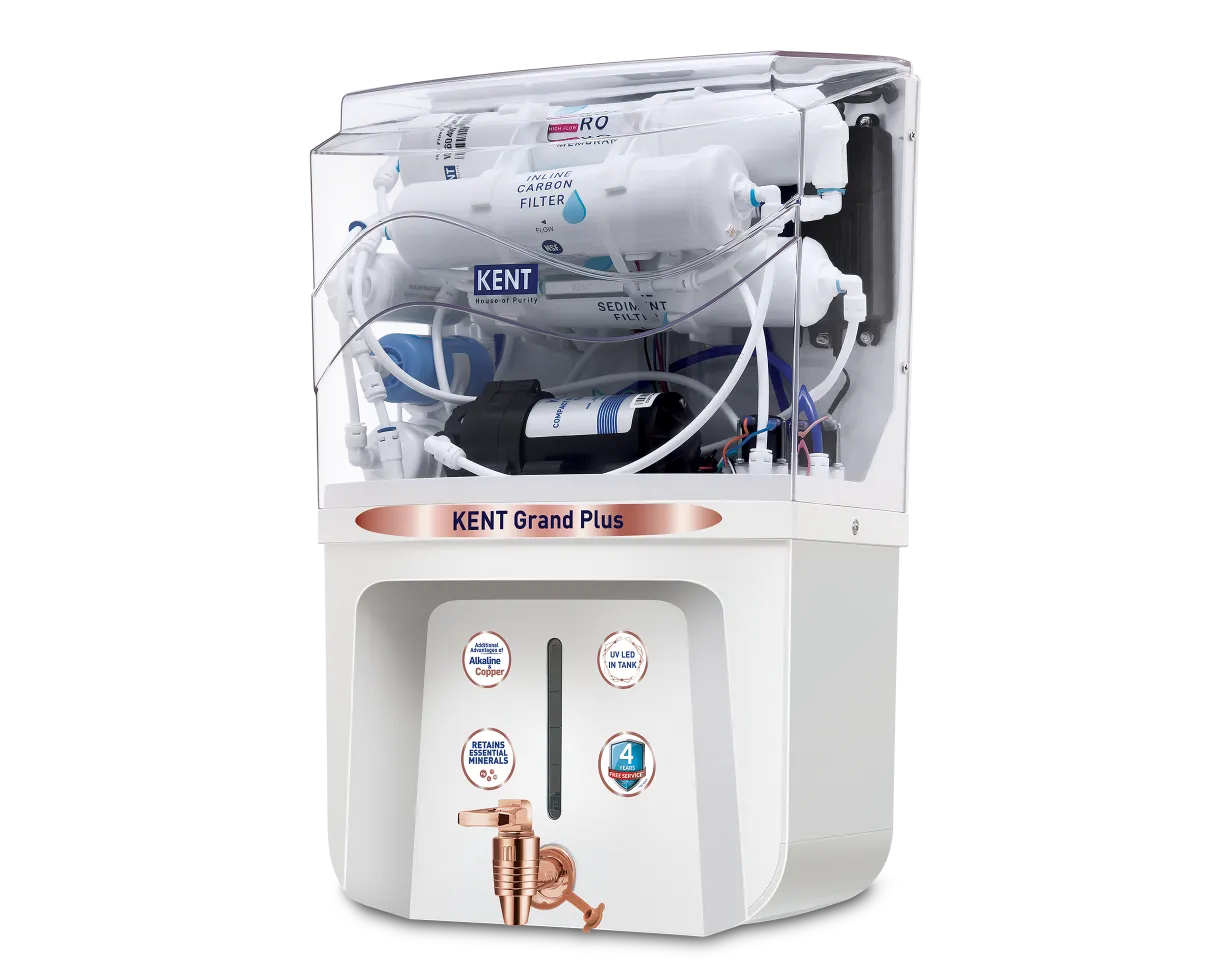
KENT Grand Plus
KENT
- RO + UV + UF + TDS Controller
- 9 litres tank
- Up to 2000 ppm TDS
Families on borewell, tanker or high-TDS municipal supply who want the safest all-round choice.
View details
LG PuriCare WW182EP
LG
- RO + Dual Protection Sterilising Care UV
- 8 litres tank
- Up to 2000 ppm TDS
Hygiene-focused buyers, humid coastal cities, and anyone who has ever opened a purifier tank and been unpleasantly surprised.
View details
Aquaguard Delight NXT
Aquaguard
- RO + UV e-boiling + UF + MTDS + Active Copper
- 6 litres tank
- Up to 2000 ppm TDS
Buyers who value service reliability and compact design over maximum tank capacity.
View details